



May 27, 2026
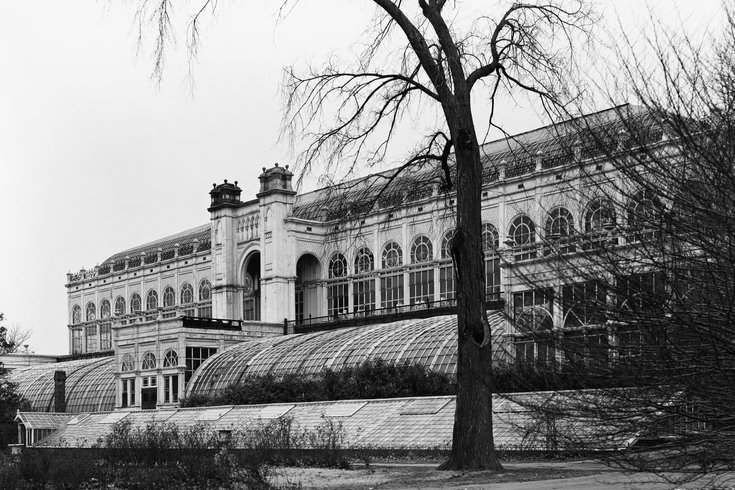 Courtesy Image/Free Library of Philadelphia, Print and Picture Collection
In 1876, Philadelphia hosted a world's fair to honor the 100th anniversary of the signing of the Declaration of Independence. The event included construction of several buildings, including Horticultural Hall in Fairmount Park, above.
In 1876, Philadelphia was a changing landscape. As the country moved through the end of the Reconstruction era, the city was swept up in the industrial age of new inventions and mass production.
But while railroad and metal workers were busy building the future of America, local leaders were planning a world's fair — the first of its kind outside of Europe — to mark the 100th anniversary of the signing of the Declaration of Independence. People from around the world descended on Fairmount Park, where hundreds of temporary buildings went up and exhibitioners showcased everything from the steam engine to ketchup.
"It leaves you with a sense of wonder and whimsy that they tried to create this grand fair that was essentially a city within a city, and they did it successfully," said Selena Austin, programs and communications manager at the Historical Society of Pennsylvania.
Ahead of this summer's semiquincentennial celebrations to honor the country's 250th birthday, here's a look at how Philly marked the United States turning 100.
Philadelphia had a population of around 1 million in 1876, and most people lived east of 40th Street and south of the present-day Frankford neighborhood. South Philadelphia stopped "about halfway down what's now the Broad Street line," said John Hepp, an emeritus professor of history at Wilkes University. And many people got around via streetcars, as the city had the largest system in the country by track mileage.
The industrial age revolutionized manufacturing and 1876 was during the peak of that era. The best-known company was likely Baldwin Locomotive Works at Broad and Spring Garden streets, which manufactured steam locomotives, Hepp said. Other prominent businesses included Midvale Steel in Nicetown and Pencoyd Iron Works in Manayunk and Lower Merion. But the most powerful was the Pennsylvania Railroad, which operated a trail line between New York City and Chicago.
However, most things manufactured in the city were created in very small industrial facilities, and families often owned their companies for multiple generations.
"Philadelphia was, back then, truly a city of neighborhoods because people worked in the neighborhood, they went to school in the neighborhood, they did their religious celebrations in the neighborhood," Hepp said. "And it would be not unusual for people to live in the same neighborhood for multiple generations."
At the time, it was still a shorter city, too. Philadelphia was still in the midst of the more than 20-year project to build City Hall, which would later dictate how high developers could go, and the tallest buildings on Market Street were likely five stories, Hepp said.
In 1866, a professor at Wabash College in Crawfordsville, Indiana, named John Campbell wrote to the city of Philadelphia to suggest a celebration to mark the 100th anniversary, and officials eventually took him up on it.
In addition to being the birthplace of America, Philadelphia was selected to host a world's fair because it was very accessible by rail, Austin said. In fact, the Pennsylvania Railroad built an extension for travelers to reach the centennial grounds, and a road was built connecting the city to Bala Cynwyd for the event.
Officials chose to host the festivities in Fairmount Park, stretching from the area around Belmont Avenue to the Horticultural Center. John Wanamaker, the creator of the namesake department store, James Welch, the organizer of the Philadelphia Sanitary Fair, and other prominent merchants worked together to find funding. The smallest financial contributor to the centennial was actually the federal government, Hepp said. The state of Pennsylvania was the largest government funder, followed by the city.
While it was 25 years since the first world's fair was held in London, all the previous international exhibits had been hosted by European cities, so the centennial was the United States' chance to prove itself as a major industrial nation.
"What it becomes is a showcase of American prowess, progress, science and innovation," Austin said. "It is an opportunity for the United States to show the world how it has developed."
The fair began on May 10, 1876, and President Ulysses S. Grant gave the opening speech. Prominent attendees and exhibitioners included abolitionists Frederick Douglass and William Still, the Kelloggs family and the emperor of Brazil, Dom Pedro II.
The fair was a hotbed of new inventions. Alexander Graham Bell was there displaying the telephone, Thomas Edison had an exhibit on an electric pen and E. Remington and Sons introduced a new kind of typewriter. One particularly famous exhibit was the Corliss steam engine, a two-story tall showcase which became a symbol of the event. The space itself was also a spectacle, as the iron and glass main exhibition building, which housed a number of prominent displays, was nearly two city blocks long and one block wide.
For the 1876 centennial celebration, crowds descended on Philadelphia to attend a fair held in Fairmount Park. With so many out-of-towners, hotels, like the one above, were built to hold tourists.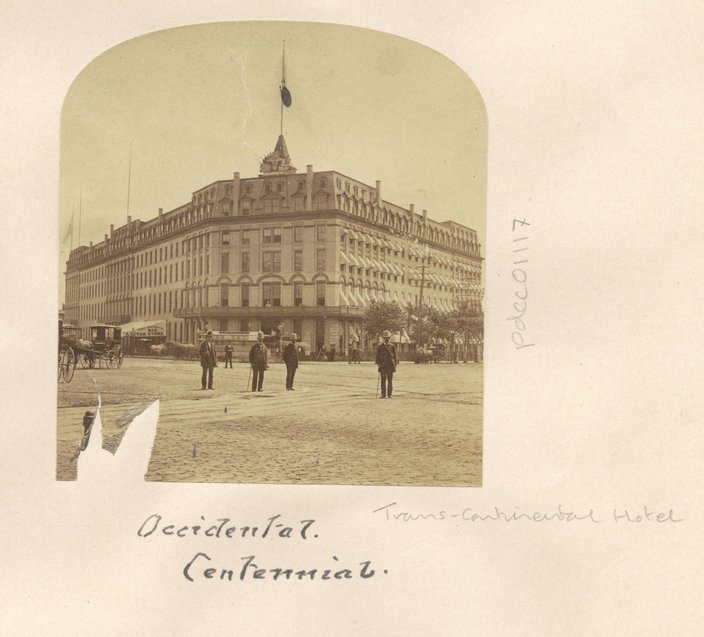 Courtesy Image/Free Library of Philadelphia, Print and Picture Collection
But it was also a display of other types of inventions, too. Austin said Heinz was there exhibiting ketchup, and many attendees tasted root beer and popcorn for the first time. The torch arm of the Statue of Liberty even made an appearance.
Since the event was so widespread, organizers decided to offer a wheelchair rental service. For a small fee, attendees who were tired or otherwise unable to walk could have a friend or family member push them around or hire a fair employee to escort them.
In total, the centennial brought 8 million visitors to Fairmount Park, a number known because there were turnstiles at the gates (although Hepp estimates another 2 million likely snuck in). Entrance cost $0.50, and on the event's busiest day, the number of people who walked through the grounds was higher than the population of Boston at the time.
"Everybody's going to the centennial, and if you have an invention or product that you want to promote, you were probably at the centennial in your own little exhibition space promoting it," Austin said.
Throughout the six months of the event, all of the out-of-town visitors stayed in nearby hotels, including a few built specifically for the event. Those temporary structures, such as one called the Globe Hotel, were built right next to the fairgrounds, housing thousands of people and serving warm food after a long day at the fair.
Though the event was viewed as a success, not everyone got the chance to participate. The city's Black residents were largely left out of the centennial.
Though Douglass was in attendance, he wasn't permitted to speak at the fair's opening. Mother Bethel AME wanted to display a statue of their founder, but it went missing en route to the fair, Austin said. In the end, only the statue's head arrived at the grounds in early November, so it barely had any time on display. And while the Ladies' Centennial Committee of Philadelphia reached out to Rebecca Cole to involve Black women, the group wanted Cole to form a separate subcommittee. Cole resisted, saying Black people should work alongside white members of the committee, and she was successful in her efforts.
"There are a lot of instances of Black participation at the centennial, but they're all disproportionate to white participation," Austin said. "They're not necessarily outright excluded, but in a way they are."
The centennial was such a success that organizers attempted to reopen it again the next year, Hepp said, but the general public had lost interest by that time and most of the exhibits and structures were gone. The 1876 event would go on to inspire the famous Chicago World's Fair in 1893, and Philadelphia officials would later hope to replicate its success during the celebration for the country's 150th anniversary.
Though the fair was in the city briefly, it had a lasting impact on the area. Many street names in Fairmount Park such as Avenue of the Republic, are leftovers from the exhibition grounds. Memorial Hall, which was Philly's first art museum and is now the Please Touch Museum, was one of the two permanent buildings made for the event. Ohio House, now home to the park's conservancy, originally housed the Ohio state exhibit at the fair. Hepp said that two of the seven public toilets for the fair also still stand, both of which are located near the Shofuso Japanese Cultural Center on Horticultural Drive.
Another building, Horticultural Hall, was meant to be permanent but was demolished after it was damaged by a hurricane in 1954.
Though most of the buildings from the fair were dismantled, they didn't disappear completely. Most of the materials were sold to local builders in 1877, so many homes and other buildings that came to life during that period were made with pieces from the centennial.
One of the most lasting effects was that the centennial helped revive the celebration of the signing of Declaration of Independence. Since Thomas Jefferson and John Adams both died on July 4, 1826, it had become less popular to hold festivities to mark that day, Hepp said. The world's fair put July 4 back on the public's radar and made the date an important one in American history again.
"In an odd sense, the centennial created our obsession with going to the Jersey Shore and having hot dogs on July 4," Hepp said.