





October 15, 2026

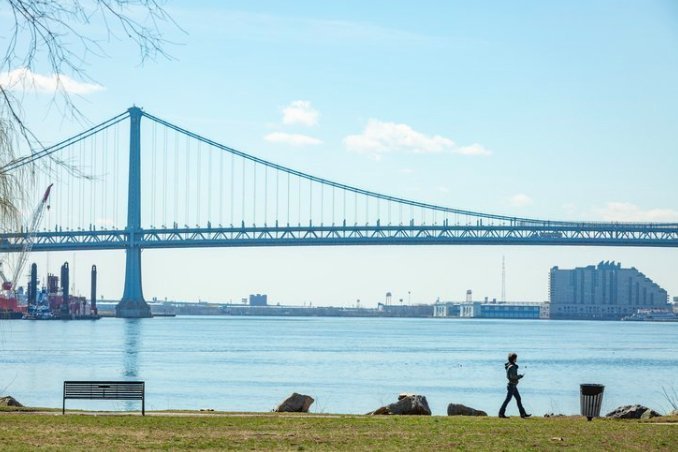 Thom Carroll/For PhillyVoice
'Forever chemicals' were detected in 98% of samples of the Delaware River south of Trenton, New Jersey, according to a a new study.
A class of synthetic substances known as "forever chemicals" have been detected throughout Philadelphia's waterways, including the Delaware and Schuylkill rivers, according to a report released Wednesday by a pair of environmental advocacy groups.
Perfluoroalkyl and polyfluoroalkyl substances, or PFAS, were found in 91% of waterways tested in New Jersey and 96% of waterways tested in Pennsylvania, according to the report from Environment America and Frontier Group.
MORE: Fight to save Lankenau High School continues with push to pass zoning bills
These manmade chemicals are formed by artificially connecting carbon and fluorine, and have been used in consumer and industrial products for decades. They are resistant to breaking down, allowing them to linger in the environment and build up in the human body. Some have been linked to various cancers, liver damage, reproductive effects and other adverse health effects.
Researchers analyzed surface water quality data conducted by federal and state agencies and nonprofit groups between 2022 and 2024 to identify how prevalent PFAS are in waterways throughout the country. They found 41 different PFAS compounds in Pennsylvania's waterways — the third-most among the 40 states included in the study. New Jersey's waterways had 20 different compounds. There are thousands of forever chemicals.
In the lower Delaware and Schuylkill rivers, where Philadelphia gets its drinking water, 98% of samples contained PFAS. Every sample taken from Wissahickon Creek tested positive for PFAS. In the Philly suburbs, the Perkiomen, Brandywine, Valley, French, Neshaminy, Chester and Pickering creeks each had 100% of their samples test positive for PFAS.
Last week, state officials issued a "do not eat" advisory for fish in the Wissahickon Creek after high levels of perfluorooctane sulfonic acid (PFOS) were found in the tissues of fish.
In a joint statement, the research groups said the findings represent the "tip of the toxic iceberg," noting that many waterways have not been tested for PFAS.
"Pennsylvania is defined by its rivers and streams," said Stephanie Wein, clean water advocate for PennEnvironment's Research & Policy Center, an affiliate of Environment America. "Whether we're paddling on the Delaware or casting a line in French Creek, we shouldn't need to worry about toxic PFAS in our favorite waterways. It's time to phase out the use of these toxic chemicals."
In South Jersey, PFAS were detected in the Cooper River, Big Timber Creek, Rancocas Creek and the Mullica River.
"Our waterways should be clean and free of toxic chemicals," said Doug O'Malley, state director for Environment New Jersey Research & Policy Center, an Environment America affiliate. "Yet, PFAS contamination of our rivers and streams is widespread. We shouldn't have to worry about tainted drinking water or catching and eating contaminated fish."
PFAS are commonly found in firefighting foam, nonstick cookware, packaging materials, cosmetics and waterproof substances. The use of two commonly used PFAS — perfluorooctanoic acid (PFOA) and perfluorooctane sulfonic acid (PFOS) — have been phased out in the United States, but the chemicals still persist in the environment. "Forever chemicals" can take up to 1,000 years or longer to break down in the environment, which allows them to accumulate in the environment and in the human body over time.