




July 17, 2026
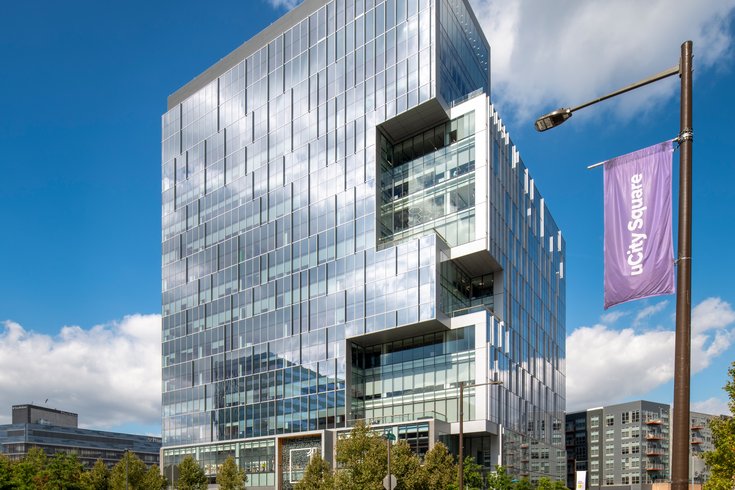 Provided Image/Wexford Science and Technology
The Monell Chemical Senses Center in University City is moving from its decades-old property on Market Street to the One uCity building at 25 N. 38th St. in early 2027. Monell, founded in 1968, is the world's only independent research center dedicated to the study of taste, smell and chemosensory science.
For nearly 58 years, the Monell Chemical Senses Center in University City has pioneered research into the ways our sense of taste and smell shape biology, behavior and the environmental factors of human health.
The nonprofit research institute remains the world's only independent organization dedicated to understanding the underlying chemistry of our senses. Monell's researchers have uncovered insights on how body odors change in response to illness, how the flavors mothers consume during pregnancy go on to affect an infant's taste, and why COVID-19 infections led many to experience changes in their sense of taste and smell.
Early next year, Monell plans to move from its decades-old home on the 3500 block of Market Street into new, purpose-built facilities at the 13-story One uCity building nearby on North 38th Street. The research institute has signed a 20-year lease to occupy the property's 11th floor and half of its second and ninth floors. Monell will look to sell its current home, unloading the real estate to help support the expansion of its research.
Monell Executive Director Ben Smith, who took the reins at the organization three years ago, explained that the move will allow for more efficient operations that utilize the strengths of Monell's research model across a similar footprint of about 64,000 square feet.
"We're not an organization like a chemistry department or a physiology department, where we have different (principal investigators) who all do their own thing, locked away in their own labs somewhere in the building," Smith said. "We have a group of investigators who come together around questions and work together."
Moving into One uCity, which has large floor plates that can be customized, will support Monell's push for more collaboration and cohesiveness around scientific investigation.
"We're designing the facilities so that they help us bring people together more and also have the flexibility so that when ideas arise and science changes, we can flip that space as needed," Smith said.
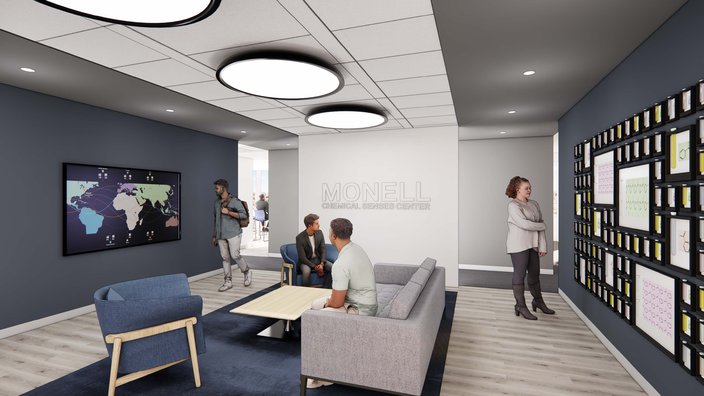
A rendering shows part of the planned new home for the Monell Chemical Senses Center at the One uCity building in University City.
With deep ties to Philadelphia's science community in academia and industry, Monell's research zeroes in on specialized studies that rely on human sensory testing. The new space will include labs for flavor and smell testing, psychophysics, genetics and brain measurements, among other areas of research impacting quality of life.
"One of the things that we're really interested in at the moment is what I call nature bio-inspired aspects of looking at health," Smith said. "We have a few researchers who are really interested at looking at how animals cope and get around their environment."
Beyond the immediacy of smell and taste, Monell's researchers are breaking ground on the internal chemical sensors our bodies have in the gut and other parts of the body. The complex field of interoception, which examines how the brain subconsciously integrates signals from inside the body, continues to uncover new facets of how people function both internally and in response to their environments.
"We're finding that many of the receptors that we thought were peripheral — the receptors in our nose and on our tongue — are found throughout the body," Smith said. "There are taste receptors, bitter receptors in the lungs that have been shown to have immune safety effects that target identifying viruses and parasites. Olfactory receptors have been found in the reproductive system, in sperm and eggs. They're all over the body and playing an important signaling role."
Monell's emerging research could be helpful in understanding the way our bodies respond to the Canadian wildfire smoke that entered the region this week, for example, or how microplastics in the environment change wildlife behavior that ripples through ecosystems. The science at Monell also informs food policy, bringing clarity to dietary questions about ingredients like sugar and MSG, while also sharpening our grasp on unseen risk factors for obesity.
"I like to think of Monell as sort of the birthplace, or at least one of the early birthplaces, that stimulated the development of sensory or chemosensory sciences," Smith said.
Monell's move comes with infrastructure investments valued at more than $30 million.
Smith, who came to Monell with a background in business and government, said keeping pace with scientific frontiers means taking risks even in an environment that has been stifled by cuts to federal grant funding in recent years. He said Monell has a strong relationship with the National Institutes of Health that have helped maintain support for research, and he believes proactively improving facilities will position Monell to attract more money and new talent.
"We feel that it's better to look at the opportunities in front of us, be bold, and say, 'How can we take the right steps to grow, understanding the environment that we're in?'" Smith said.
One uCity, completed in 2023, is part of the larger uCity Square research district that's been master planned and developed by Baltimore-based Wexford Science & Technology over the last decade in partnership with University City Science Center. Projected growth in University City's life sciences sector is among the top reasons Monell chose to stay in the neighborhood, even as areas like the Navy Yard, Center City and North Philadelphia see new research-oriented development. The institute wants to remain an anchor in University City and strengthen its ties with scientists at the University of Pennsylvania, Drexel University and industry partners who see the benefits of sensory research.
"Monell has been here from the start," Smith said. "We want to keep going, but we want to be looking at how we can be doing more and leveraging more the opportunities that Philadelphia gives."