



May 26, 2026
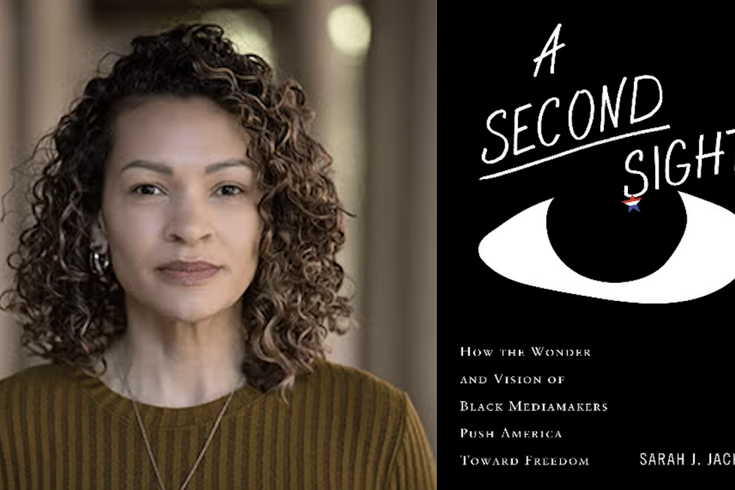 Provided Images/University of Pennsylvania, HarperCollins
‘A Second Sight’ by Penn professor Sarah J. Jackson explores the impacts of Black mediamakers on American culture and politics.
Growing up as a Black girl in Salt Lake City, Utah, Sarah J. Jackson was always acutely aware of how racial stereotypes in the media impacted how she and her family were perceived by the predominantly white community around them.
“I saw from a very early age that there was enormous power in how stories were told, who got to tell those stories and how, as a result, the public comes to understand the most pressing issues around them and their fellow citizens,” she said.
MORE: Barn collapses at Bucks County property once owned by musical theater icon Oscar Hammerstein II
As an author and associate professor at Penn’s Annenberg School for Communication, Jackson has dedicated her career to interpreting how race, class and gender shape how media is communicated and received. With her new book, “A Second Sight,” she sought to take a sweeping look at the impact of Black storytellers on the founding and evolution of the country — from the poems of enslaved writer Phillis Wheatley to Ryan Coogler’s Oscar-winning blockbuster “Sinners.”
“A Second Sight,” which comes out on June 16, makes the argument that Black storytellers have an inherently unique perspective on the American experience that, when told, exposes an underlying truth about societal structures in place before other mainstream sources.
Jackson writes that throughout the country’s history, Black journalists, photographers and filmmakers have been on the front lines of pushing for an advancement of democratic values while simultaneously being overlooked and targeted. She likens these storytellers and cultural institutions to “canaries in a coal mine” — often the first, but rarely the last, targets of censorship and violence.
“At many moments in history, you see Black stories become wildly popular and wildly sought after because they're naming things about our country and our relationship to other people that others haven’t named before,” Jackson said. “There’s a demand for that alternative way of understanding the country. … The way that comes under attack is something that the country really has to grapple with.”
One of the most prominent examples that exhibits the persecution Black storytellers face in the book is in the context of the 1985 MOVE bombing in Philadelphia, when the city's police department dropped explosives on the residential home of a Black liberation group in West Philadelphia, killing 11 people.
Jackson interviewed journalist Gene Demby, a Philadelphia native who was 4 years old when the bombs were dropped. While working for NPR in 2015, Demby sought to tell the stories of the people it impacted and how it shaped policing in his hometown for the decades to come. Five years after his work was published, calls for social and police reform became more mainstream conversations, Jackson said.
“He was telling these stories before the so-called 'reckoning,'" Jackson said. “He saw that the public could have a better understanding of how Black communities have been impacted by police and state overreach by telling these stories. … This is something remarkable about second sight, which is the persistence that there is something to learn here.”
In her previous works, “#HashtagActivism” and “Black Celebrity, Racial Politics, and the Press: Framing Dissent,” Jackson has explored similar intersections of race and media, but “A Second Sight" takes a broader research scope. She conducted dozens of interviews with modern-day journalists and filmmakers and also dug through archives of the Penn library to find fitting historical counterparts.
“I take these really important historical moments and these really contemporary moments, figures and stories, and I explain how they’re in conversation with each other in terms of how we understand and think about American politics,” she said.
Take the comparison between Wheatley and “Sinners.” On the surface, the poems from the first published African-American author about the horrors of slavery and a sci-fi thriller about vampires in the Jim Crow South may not have much in common. But Jackson argues that both storytellers attempt to show their audiences something about the future of the country.
“Phillis Wheatley was showing that a person who has been so dehumanized is equal in their ability to narrate a story. …Similarly, ‘Sinners’ is telling us something about the country in terms of its labor exploitation and its history of taking from Black culture,” she said. “It’s not just one person. It’s not just one time period. People make revolutionary media and it helps us think bigger and have greater imaginations about what freedom and democracy means.”
To Jackson, the stories that weave together in “A Second Sight” are directly correlated with the 250th anniversary of the signing of the Declaration of Independence. The sections in the book are fittingly titled “Life,” “Liberty” and “Pursuit of Happiness” and the book has already been named by Publisher’s Weekly in a list of essential readings to understanding the state of the country during its semiquincentennial this year.
“One of the things I really want to do with this book is make the case that these stories of Black mediamakers are for everyone in this country,” Jackson said. “From the very start, Black Americans have taken those values earnestly and seriously and thought about how we can create a nation where everyone can have the same rights, liberty and justice for all.”