



May 29, 2026
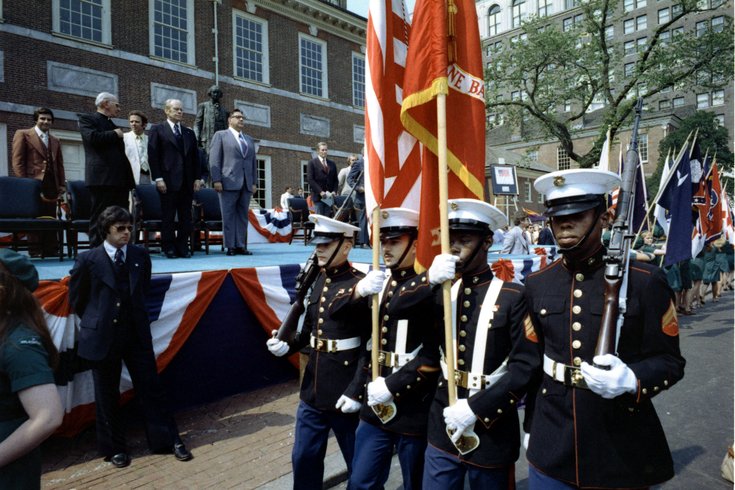 National Archives and Records Administration/Public domain, via Wikimedia Commons
President Gerald Ford delivered a speech to a crowd in front of Independence Hall in Old City on July 4, 1976.
The political environment surrounding the 1976 bicentennial created divisions along party lines and distrust in federal officials — sentiments that aren't far different from the current state of the country, local historian Jeffrey Hyson said. In other words, it was a milestone birthday for America, but no one wanted to have a party.
"The concept of a national celebration of independence is about a celebration of institutions ... it's about a celebration of the government that was created," said Hyson, a professor at St. Joseph's University. "Both in 1976 and in 2026 you have an American society that really doesn't have faith in a lot of those institutions, and so from the start it compromises the ability to craft an effective celebration when the things that are allegedly being celebrated aren't necessarily working the way that a lot of Americans wanted."
With the country still teetering from a presidential impeachment and an unpopular war abroad, Philadelphia officials opted for a quieter anniversary than the successful world's fair of 1876 and the disaster world's fair of 1926. While 1976 commemorative memorabilia flooded the market, the city followed a national trend and held small events primarily in the summer.
Ahead of this year's semiquincentennial celebrations to honor the 250th anniversary of the signing of the Declaration of Independence, here's a look at how Philadelphia marked the country's 200th birthday.
America bounced between political controversies in the early 1970s, going from the Vietnam War and the protests surrounding it, to the 1973 oil embargo that triggered gas rations and long lines at the pump, to the Watergate scandal that led to President Richard Nixon's resignation to avoid impeachment in August 1974.
In Philadelphia, it was a decade led by Frank Rizzo, the former police commissioner who was elected mayor in 1971 and left a violent legacy. Police officers shot civilians on average once per week from 1970 to 1978, the Inquirer reported. Rizzo, who referred to himself as the toughest cop in America, often went head-to-head with civil rights activists. However, he remained popular and easily won reelection in 1975.
"The '70s was a pretty bleak decade here," said Brent Cebul, a professor at the University of Pennsylvania. "It was a sort of quiet and sad interregnum between the tumult of the '60s and some of the tumult of the '80s."
At the same time, there was a huge decline in manufacturing jobs, which was devastating for a city economy propped up by industrialization. Urban renewal projects, a national effort in the late 1960s to revitalize cities by demolishing run-down areas which often left residents displaced, began in neighborhoods now known as Society Hill and University City. But while demolition and construction had begun, some of the promised long-term redevelopment efforts wouldn't begin until the 1980s, Cebul said.
"There were really big scars in the urban fabric that I think are visual metaphors for the pains that a lot of people were going through with the industrialization and also suburbanization that began earlier in the decade but was accelerating by the '60s and '70s, people moving out the city," he said.
With the tumult of the previous few years, bicentennial planning had one major problem: no one really wanted to celebrate. At the executive level, it would be led by President Gerald Ford, who hadn't been elected president but instead took office following Nixon's resignation. At the same time, governments were grappling with movements such as women's liberation and Black Power, where people were redefining what it means to be an American and noting their previously unsung presence in American history, Cebul said.
Thus, the prospect of putting together a "top-down celebration" was daunting to officials. Many thought that a decentralized approach would be a better political move, and local celebrations better reflected the nation's appetite. But even with that move, many people just weren't feeling very patriotic, especially given the economic struggles.
"It becomes very hard to imagine in a unifying celebration in that social, political climate," Hyson said.
The initial event planner was a group called the American Revolution Bicentennial Commission. But during his administration, Nixon was accused of co-opting it and the group was met with corruption allegations following leaked government documents known as the Bicentennial Papers. A new group called the American Revolution Bicentennial Administration was later formed, but by the time that came along, there wasn't much coordination or funding from national officials, Hyson said.
With the lack of a national agenda, Cebul said that capitalism rushed in to fill the void. By 1976, the end result was many small, regional celebrations and a flooded market of Bicentennial-themed memorabilia, such a coins, clothing and even condoms. Kellogg's held a contest asking consumers to draw their favorite founding father eating breakfast, and various companies plugged red, white and blue ice creams, placemats, sugar packets and even period products, the New Yorker reported.
"The narrative got dominated by commerce, and so when ended up getting a lot of attention at the time from opinion writers and late-night TV hosts and things like that, was just the amount of commercial schlock that flooded the market," Cebul said.
Still, he thought there was a collective regret about the inability to "pull together a coherent party" and the narrative that it would spread.
"I think that probably contributed to some of the disappointment, that it didn't rise above other types of celebration," Cebul said. "But again, I just don't think most people's hearts were in it." Above, a group called Vietnam Veterans Against the War holds a demonstration amid the bicentennial celebration in Philadelphia.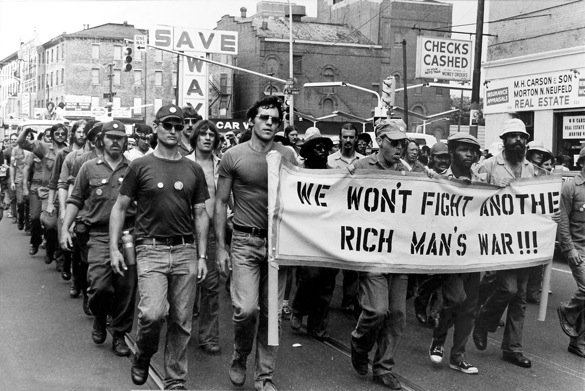 Public Domain/via Wikimedia Commons
In Philadelphia, officials initially sought another world's fair-style event led by urban planner Edmund Bacon, and the city was also set to host Documenta, a famous German art show. Both the Delaware riverfront and the rail yards along the Schuylkill were floated as possible locations. But neither of those plans would come to life.
According to Hyson, it's not necessarily fair to blame the bicentennial for that since, there were a lot of urban planning projects proposed in Philadelphia in the 1960s and 1970s that never panned out. But in his opinion, officials were overly optimistic about what the celebration could do for the city.
"The idea that the bicentennial would be this opportunity for Philadelphia to rebuild itself and emerge out of the so-called urban crisis period of the 60s and early 70s, that just didn't happen," Hyson said. "It was obviously a location where a lot of tourists wanted to come, but it wasn't like there were some massive new projects that were part of attracting people."
Another problem was the narrative from the Rizzo administration and other officials that the events would draw protestors and create possible safety issues following national conflict. In 1971, a group called the People's Bicentennial Commission was formed. They would eventually leak the documents exposing the American Revolution Bicentennial Commission's collusion with the GOP and held an anti-big business protest in Washington on July 4.
"That concern about protesting that was voiced by the administration ironically winds up turning some tourists away because they're being told by the folks that run the city, 'Well, there could be some radicals out here trying to make trouble,'" Hyson said.
Still, the city did manage to get a few things off the ground. Much like 2026, Philadelphia hosted NCAA Final Four basketball games and all-star games for hockey and baseball in 1976. Neighborhoods held concerts and street fairs in the first half of the year.
On the actual day, the Sara Lee Company brought a giant birthday cake to the Memorial Hall in West Fairmount Park, which now houses the Please Touch Museum. President Ford traveled to Valley Forge to meet a group of people traveling in covered wagons to honor their pioneer ancestors and dedicated the area as a national park. He then headed to Philadelphia, where he delivered a public speech to a 1 million-person crowd gathered at Independence Mall and a private one at a ball hosted by Rizzo. The African American Museum in Philadelphia opened its doors in the midst of celebrations, and the day was capped off with a firework show.
A few days later, Queen Elizabeth II and Prince Phillip delivered a Liberty Bell replica known as the Bicentennial Bell, which is now on display at Benjamin Rush Garden at 3rd and Walnut streets.
"In some ways, it's kind of a super-sized version of (Wawa) Welcome America," Hyson said.
In September, the Women for the Bicentennial group buried a time capsule in Old City with letters from Rizzo and Governor Milton Shapp, photos and the names of 816 children. The group plans to open the capsule during this year's semiquincentennial celebration. Both the Mummer's Museum and the Mann Center also opened that year in honor of the event.
Outside of the museum and the time capsule, there wasn't much of a physical legacy in the same way that the 1926 celebration brought forth FDR Park and JFK Stadium, and the 1876 celebration created several structures in Fairmount Park. The closest thing Hyson could point to would be the Liberty Bell Pavilion opened at Independence Mall, but it was demolished in 2003 and moved.
But the lack of urban renewal changes might actually have been a good thing in the long term, he said, with mid-century trends such as highways cutting through cities and federal subsidies used to clear people out of dilapidated areas which displaced many residents.
"Maybe that's actually kind of a blessing in disguise, because there also were so many examples of urban planning in Philadelphia and elsewhere in the '60s and '70s that transformed cities in ways that we're only now grappling with legacies of," Hyson said.
However, one positive effect of the localized celebrations was the attention it garnered toward small historical organizations. Both the trend of looking back and a popular TV show called "Roots" created a growing interest in genealogy, and many looked to historical societies to track down the birth certificates, marriage licenses and other records of their ancestors.
But with all that new information, many were left wondering about how to share that history in a time of great social and political divide, which Hyson said feels similar to the current environment.
"In the ways that we're trying to figure out the best way to organize a national celebration in a nation that's very divided, it's also very hard to tell a national story when ways of telling that story are very contested," Hyson said.
This story was updated after publication.