







May 26, 2026

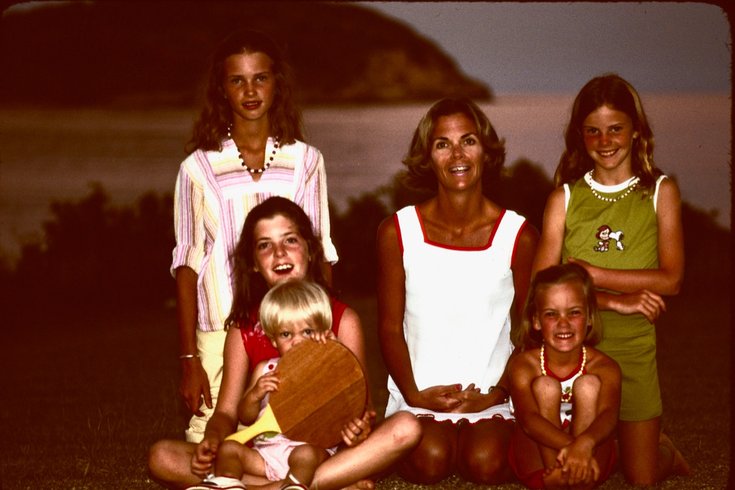 Provided Image/Courtenay Harris Bond
People didn't really wear sunblock when Courtenay Harris Bond was little, although it looks like, from this picture, that her mom did wear sunglasses. Courtenay is pictured on the bottom right.
I will be dating myself when I say that I grew up at a time before sunscreen was really a thing.
It was a thing if you counted Bain de Soleil, which was limited to SPF 2, 4 or 6. A 1980s jingle, almost as smooth as the orange gel, itself, marketed Bain de Soleil "for the San Tropez tan." When Bayer finally discontinued the product in 2023, Air Mail writer Lianna Schaffner characterized it as "the beloved French sunscreen that was only partly French and never a sunscreen."
MORE: Children are increasingly visiting doctors for anxiety and other mental health issues, study shows
Diehard sun-haters wore a thick white smear of 100% zinc oxide on their noses in the 1970s and 1980s. But more often than not, you'd see women at the beach slathering on baby oil. It was a time when people still held aluminum-covered sun reflectors under their faces, a time of DIY highlights with hydrogen peroxide, or for the bougie among us, Sun-In and sunlight to be "blonder tonight."
Clearly, I could not escape the times and wound up with an inconvenient number of sunburns. The early ones were not my fault. I blame my parents, who made us participate in outdoor summer activities, such whacking tennis balls back and forth for hours on smoldering courts and bobbing down icy Idaho rivers in thick inner tubes that had a perverse way of getting sticky in the heat.
An old family photo shows my cousin and my dad after a day's float, scorched, dripping wet and smiling. Then there's this one of me on some long-gone summer morning, still in my nightgown, smiling big for the camera with blazing red cheeks and a blistered nose.
Courtenay Harris Bond is pictured as a child in the 1980s — happy, smiling and sunburned.
But even after I had learned better, and my parents had started insisting that I put on at least an SPF 8-layer of coverage, I resisted. I spent middle- and high-school summers on Lake Washington in Seattle, where I grew up, doggedly avoiding sun protection. I made a hobby of peeling sunburned skin from my shoulders and legs when I got bored.
I also had a fair share of sun exposure skiing in Idaho's Smoky Mountains, which, in the springtime, weren't so smoky. The sun and heat radiated off the snow, onto our faces. My older sister and cousin used to sneak little bottles of baby oil in their parka pockets to apply furtively to their faces on the chairlift, out of view of my parents. I was never that brazen.
But I am still suffering from post-traumatic stress disorder from the time my father exhorted me, on my way out of the door to the mountain, to "Put on sunblock!" Angry, I smeared some across my face without rubbing it in. By evening, I had stripes of sunburn slashing my visage and bright pink circles around each eye, a monster of my own making.
I am also emotionally-scarred from a sailboat ride with my friend Holly, whose parents took us to Maui for spring break during our sophomore year of high school. Holly and I decided to lay out on the bow all day. By nightfall, I was chattering and feverish with sun poison. Luckily, Holly's mom was very nice about it and kept saying, for some reason, that it was "all her fault."
Now, I spend my time outdoors, slathered up and buttoned-down, dowdy in my floppy hats. And twice a year, I have to see my dermatologist for "mole scans" – appointments at which he inevitably removes something, "just to be sure it isn't anything," meaning skin cancer. This careful man has left a minefield of scars on my back, but thank goodness, nothing worse.
As I reflected back on this overexposed history, I realized it would be selfish to hoard my hard-won knowledge. So here are some tips for protecting your skin – the body's largest organ – from sun damage and skin cancer, which 1 in 5 people will have by age 70.
• Don't even try to look for lotions with SPF 2 or 4. They don't exist anymore (I don't think). And even if they did, they wouldn't do any good. Yes, Europe and Asia have way better sunscreen than us. It's bonkers, but the United States is shooting itself in its own sunburned face, hung up by some law from 1938.
• Wear sunblock with a minimum of 15 SPF on exposed skin, every day, during all seasons.
• Reapply sunscreen about every 2 hours, or more often when swimming or exercising.
• To be really careful, wear long sleeves and long pants, even when it's hot, plus a hat that covers the ears and sunglasses that wrap around the face.
• Try to stay in the shade.
• People with a history of skin cancer, or who those who have had severe sunburns and blistering, like me, should see a dermatologist for a mole scan at least annually. The Mayo Clinic also recommends that people who have used tanning beds (yes, guilty) or who have irregular, "suspicious-looking lesions," see a dermatologist.
Wirecutter also has this list of the four best sunscreens for 2026.