



April 29, 2026

 Courtenay Harris Bond/PhillyVoice
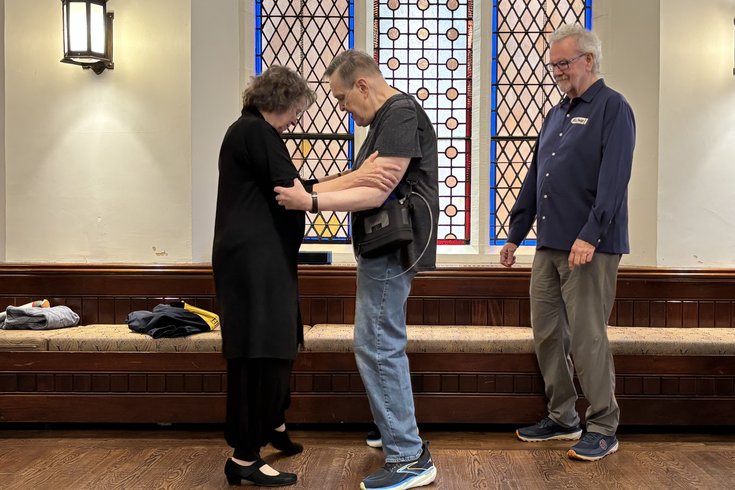
Bill Wilson, center, takes classes with the Tango Therapy Project to help with his Parkinson's symptoms. Volunteers Caroline Young and Michael Hoad also are pictured.
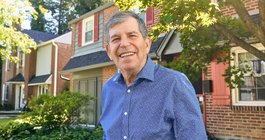
Neil Godick learned six months ago that he has Parkinson's disease, but he says he wears his "diagnosis as a badge of honor." Still, Godick, 84, also has had a series of falls.
As part of his treatment for Parkinson's, a progressive movement disorder that affects balance and mobility, Godick's doctor recommended he get involved in the Tango Therapy Project, a Philadelphia program that teaches a form of Argentine tango modified for people with Parkinson's. Godick started classes during the winter and signed up for a second session at the First Presbyterian Church of Philadelphia this spring.
MORE: CDC's new hepatitis B vaccine recommendations will cause more infant infections, studies find
"I've learned how to walk backward again, and I haven't fallen in at least 10 weeks," said Godick, who lives in Bala Cynwyd. "I'm much more confident in how I walk."
Parkinson's symptoms can set in gradually, starting with slight tremors and eventually causing difficulties with gait, balance, coordination, speech, and stopping and starting movements. Tango can help with all of these issues, said Carolyn Merritt, a tango instructor and co-executive director of the Tango Therapy Project.
"People are working on all of the skills that they would work on in a physical therapy session, for instance, but they're doing it in a social atmosphere," Merritt said. "They have the element of physical touch, and they're building community with people."
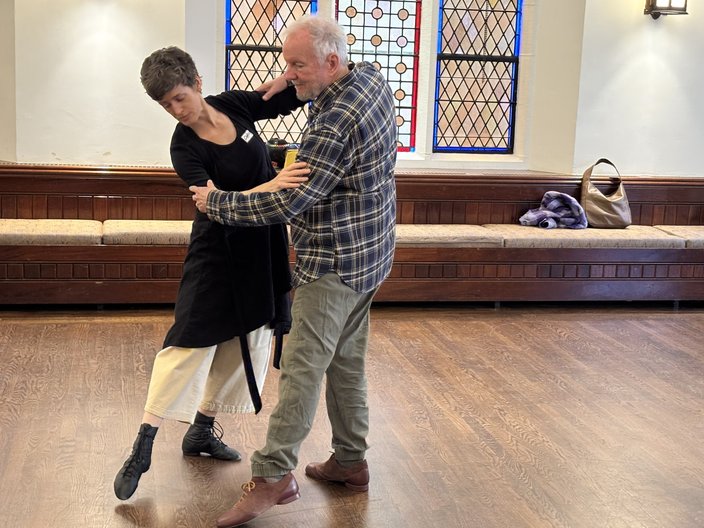
Tango Therapy Project instructors Carolyn Merritt and Ross Alexander demonstrate steps at a class Wednesday for people with Parkinson's disease.
A wide body of research supports the efficacy of dance therapy for helping older adults improve movement, mental health, cognition and overall well-being. Tango, in particular, has been shown to help with mobility and gait in people with dementia and to improve symptoms in people with Parkinson's.
Débora Rabinovich, a researcher who helped start a tango therapy program in Argentina for people with Parkinson's Disease, recently told the New York Times that "tango uses the same kind of movements that people with Parkinson's disease tend to lose."
It's also an "opportunity for people to have joy and community and culture altogether," said Jocelyn Russell Wallace, the Tango Therapy Project's co-executive director. "The thing about tango is, you can't do it alone."
The Tango Therapy Project currently is holding two series of adapted tango for people with Parkinson's. One takes place Monday mornings at the Salem Adult Citizens Center in Abington; the other occurs Wednesday mornings at the First Presbyterian Church of Philadelphia.
The project, which started three years ago, also is developing programs for people who have had strokes and for people with cognitive issues, conducting focus groups with participants and getting guidance from medical experts, some of whom sit on its board.
At the start of Wednesday's class, participants and volunteers sat in metal folding chairs in a large circle for a 5-minute warm-up, reaching in the air, swaying side to side and drawing circles, known as lápiz, on the floor with their feet. Then people stood, using the chairs for balance, extending their legs and tapping.
After moving the chairs out of the way to practice walking to the basic slow-slow-quick-quick-slow tango rhythm, people partnered up, using an adapted-tango embrace, connected at their forearms, in part to help prevent falls.
Couples circled the room counterclockwise, the partner facing forward guiding the partner moving backward.
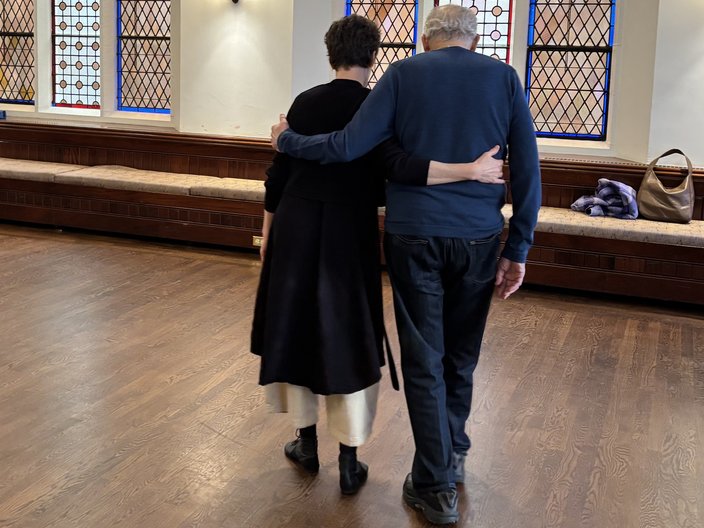
"Tango is a dance that's based on walking and hugging somebody," Merritt said, "and that makes it very accessible."
'Tango is based on hugging someone and walking with them,' says Carolyn Merritt, the Tango Therapy Project's co-executive director. Here she walks with Neil Godick in a tango class adapted for people with Parkinson's.
Bill Wilson said he always loved dancing, especially disco at gay clubs like the Allegro and the Steps when he was younger. Wilson is admittedly a bit slower now that he is 75, has Parkinson's and carries an oxygen machine. But he's still out there on the floor every Wednesday morning for tango.
"It helps me pay attention to my movement, to how I'm walking," Wilson said.
He also enjoys getting to know other people with Parkinson's and socializing with the volunteers, who range from college age through their 70s.
"When I started here, I didn't know how disconnected I was from my body," said Carmen Pendleton, an artist with no dance training, who volunteers with the Tango Therapy Project. "It's taken a year-and-a-half for me to loosen up and get reconnected with my body."
Pendleton said she saw getting involved as a "way to serve others. But it's ended up serving me."