





July 15, 2026

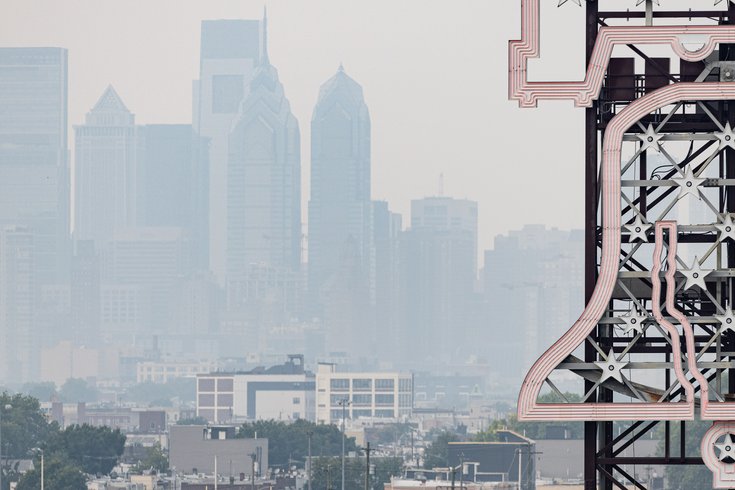 Bill Streicher/USA Today Sports via Reuters Connect
Smoke from ongoing wildfires in western Ontario is expected to reach the Philadelphia region on Wednesday night. The smoky conditions may be the worst since June 2023, shown above, when wildfire smoke prompted Code Red air quality alerts in Philly.
Smoky air is expected to enter the Philadelphia area Wednesday night as a result of ongoing wildfires in Canada, the National Weather Service forecasts.
The hazy conditions are anticipated to be the "most prevalent" the region has experienced since the 2023 summer, when wildfire smoke prompted the Pennsylvania Department of Environment Protection to issue a Code Red air quality alert, said Joe DeSilva, a NWS meteorologist based in Mt. Holly, New Jersey. But he said it's too early to predict the full impact.
MORE: Amtrak trains to run at reduced speeds due to heat wave
"This is the kind that you'll be able to smell outside, reducing visibility and potentially causing air quality issues," the NWS said in a social media post Tuesday night.
🔥 While today's Canadian wildfire smoke was aloft, we are unfortunately anticipating near surface smoke to spread into the region Wed evening and Thurs. This is the kind that you'll be able to smell outside, reducing visibility & potentially causing air quality issues. (1/2) pic.twitter.com/IRyKELh4ym
— NWS Mount Holly (@NWS_MountHolly) July 15, 2026
The smoky skies are expected to last until at least Friday, but the timeline for the smoke's disappearance is mostly dependent on how quickly Canadian responders can get the wildfires under control, DeSilva said. The NWS' forecasts for smoky conditions can predict up to 48 hours in advance. As of late Tuesday, the largest portion of the blaze in western Ontario had grown to more than 130,000 acres, the Washington Post reported.
"As of right now it's definitely going to be the most prevalent since that 2023 event," DeSilva said. "... I think generally our entire area is going to be affected by this."
People with heightened sensitivity to poor air quality should take precautions or prepare to stay inside, because wildfire smoke can irritate the eyes, lungs, nose and throat, DeSilva said. Children, older adults, outdoor workers, pregnant women and people with asthma, lung diseases, and heart conditions are among the most vulnerable to wildfire smoke, the Pennsylvania Department of Health says.
Inhaling wildfire smoke can cause coughing, chest pain, shortness of breath, headaches, rapid heartbeat, stinging eyes and irritated sinuses. People who experience these side effects are advised to seek medical attention.
Air quality in the United States usually is measured on a fine particulate matter index of 0 to 500, standardized by the EPA. A range of 0 to 50 is considered good, but a range of 101 to 150 is considered "unhealthy for sensitive groups" and prompts a Code Orange alert. The next tier of 151 to 200, considered broadly unhealthy, rises to Code Red. Code Purple, which ranges from 201 to 300, means the air quality is "very unhealthy." Only Code Maroon, when the air quality is labeled "hazardous," is worse.
The Pennsylvania Department of Environmental Protection issued a Code Red alert for Thursday because high amounts of particulate matter concentrated are expected to be in the air. Under a Code Red, the following precautions are recommended for everyone, according to state health officials.
• Avoid strenuous outdoor activities
• Keep doors and windows closed
• Don't smoke or use candles inside
• Use an air filter inside if possible
• Bring pets inside
Also, portions of Southwest Philadelphia and Delaware County may be impacted by a large junkyard fire that ignited Wednesday in Darby Township. Philly health officials were dispatched to asses the air quality in the area, city officials said.
Residents are encouraged to recirculate the air inside their homes with fans to avoid bringing more pollution inside. They also are advised to avoid areas of heavy congestion — where air pollution may be higher — and to monitor for symptoms while health officials investigate the situation.
Residents also can check the Breathe Philly air monitoring network, which provides real-time levels of particulate matter and nitrogen dioxide from 76 stations around the city.
The air quality concerns are overlapping with an extreme heat warning issued by the NWS for the Philadelphia region, which is expected to last until 8 p.m. Wednesday. Temperatures are expected to reach the upper-90s and potentially triple digits, and the heat index could reach between 100 to 108 degrees through Thursday.
Temperatures likely will come down if wildfire plumes are thicker and denser, because the air particles in the smoke clouds trap sunlight, providing a cooling effect on the surface below, DeSilva said.
Isolated severe thunderstorms with potentially damaging winds are expected after 4 p.m. Wednesday in areas near, north and east of Philly, with a more widespread chance of rain expected on Saturday.
⚠️🥵⛈️ Dangerous heat today with highs in the upper 90s to near 100° and heat indices 100-109° for most. There is also a threat of isolated severe storms (damaging winds main threat) after 4 PM near, north, & east of Philly. Surface smoke arrives tonight. #PAwx #NJwx #DEwx #MDwx pic.twitter.com/F1jxii5HQA
— NWS Mount Holly (@NWS_MountHolly) July 15, 2026