





April 14, 2026
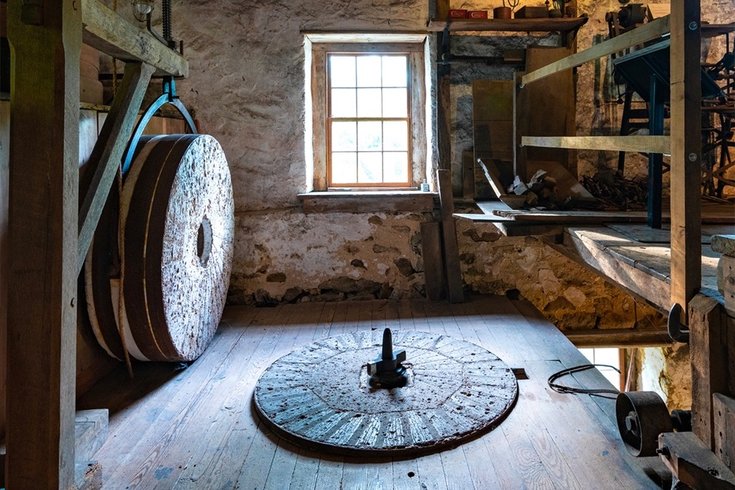 Provided Image/The Mill at Anselma Preservation and Educational Trust
The original wheat stones used to mill flour at the Mill at Anselma, above, are now in use for the first time since the 1880s.
A Chester County mill has revived a set of wheat stones used for grinding flour, putting them into use for the first time in nearly 150 years.
The Mill at Anselma, a national historic landmark, was built in 1747 as a water-powered grain mill along Pickering Creek in Chester Springs. Over the years, it has transitioned from a corn and wheat mill to a machine shop to a historic site. But as of Saturday, the mill's grinding stones, last used in the 1880s, have been fully restored to active production.
"It was a mix of original machinery and refurbished machinery to get it running, but it runs exactly like it was in 1747," said miller Dave Rollenhagen. "When you walk in the door of that mill, what you see is what was here in 1747."
For years, visitors have been able to see mill demonstrations and purchase grained milled on the "corn side," the portion of the mill that grinds corn. But the "wheat side" sat dormant, needing months of restoration to make it operable. Last August, the Mill at Anselma Preservation and Educational Trust attempted to revive the wheat side, but was stopped by mechanical issues.
For Rollenhagen, restoring the wheat stones is an opportunity to bring back a piece of history to a site that's been well-preserved. He said it was unusual that a previous owner kept the machines functional, even though he didn't have any plans to mill grains.
"It's rejuvenating a historic machine capability, and as far as we know, we're the only mill in the country that is actually restored and operating to its original 1747 design," Rollenhagen said. "Nothing has ever been changed. It's just been maintained."
When the mill was built, local farmers would bring their wheat to the mill to have it ground into flour. The mill later took on more of a commercial model, Rollenhagen said, with the owner paying farmers to bring their wheat to the mill. It would be turned into flour and exported. When the inventions of automobiles and the portable grist mill threatened the business, and the area switched to mainly dairy farms, the mill's primary use became grinding corn into feed.
Then from 1919 to 1982, former owner Oliver Collins used the mill to run a sawmill, a cider press, a metal working shop, a barbershop and a lawnmower and machine repair business. In 1999, ownership of the property was transferred to the Mill Trust, which began repairing the property's buildings. In 2004, the mill began grinding corn for the first time since 1934.
A colonial bread oven was added in 2018, and the water wheel was restored in 2024. Rollenhagen said he's able to handle a lot of the maintenance to keep things in operation, but fully restoring the mill was beyond his capabilities. The historic landmark hired a millwright to fix a warped master gear, realign the shaft and correct issues with the stonework and cogs, among other repairs.
Mill demonstrations are held on the second Saturday of every month from April through December, and the mill will be selling flour made at the facility while supplies last.
Rollenhagen said the mill wants to sell 200 pounds of cornmeal and 200 pounds of flour throughout the season. Products made at the mill retain the wheat germ and have a protein level of about 9%, meaning the flour contains a unique taste and is ideal for making pastries.