






September 23, 2026

 Provided Image/Children's Hospital of Philadelphia
Preterm babies are at higher risk of early language delays and reading challenges with reading and spelling. At CHOP, families with preterm babies can participate in NICU Nest Read to My Preemie program, which offers free books, educational workshops and support.
Thirteen years ago, Jenne Johns gave birth to her son, Tochi, a micropreemie who weighed less than 1 pound. He spent 77 days in the neonatal intensive care unit, an experience that prompted Johns to write "Once Upon a Preemie," a children's book to help NICU families bond with their babies.
Now Johns's nonprofit, Once Upon a Preemie, has partnered with the Children's Hospital of Philadelphia to promote early literacy for preterm babies and their families. The NICU Nest Read to My Preemie program, which aims to help at least 100 Philadelphia families, is funded by a $165,000 grant from the William Penn Foundation.
MORE: Health officials warn of a measles exposure at the Philly airport
"Preterm babies face a higher risk of early language delays and challenges with being ready for kindergarten and reading and spelling, especially the younger that they are," said Dr. Diana Montoya-Williams, a neonatologist with CHOP's Division of Neonatology. "The earlier that they're born, the more likely that they are to not have that full third trimester when so much brain development is happening in utero. So, for our preterm babies, we're trying to overcome those challenges."
Research shows that babies born preterm perform worse as school-age children on reading measures than babies delivered at full term. A 2021 study found that even being born a few weeks early was linked to higher risk of worse performance in math and language arts, as well as chronic absenteeism and suspension from school, compared to children born full term.
More recent studies confirm these findings but also show that higher levels of parental education helps buffer these negative outcomes and highlights the need for more interventions for preterm babies and families.
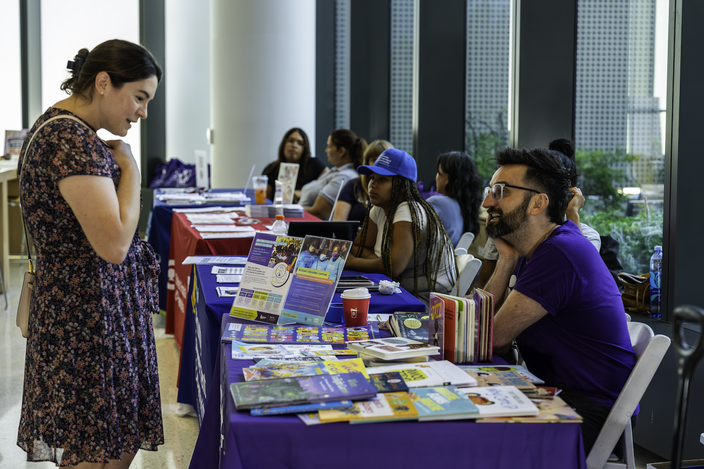
Amanda Charles, of the William Penn Foundation, and Clifton Drees, of the Read by 4th Community Project, participate in a recent Read to My Preemie event.
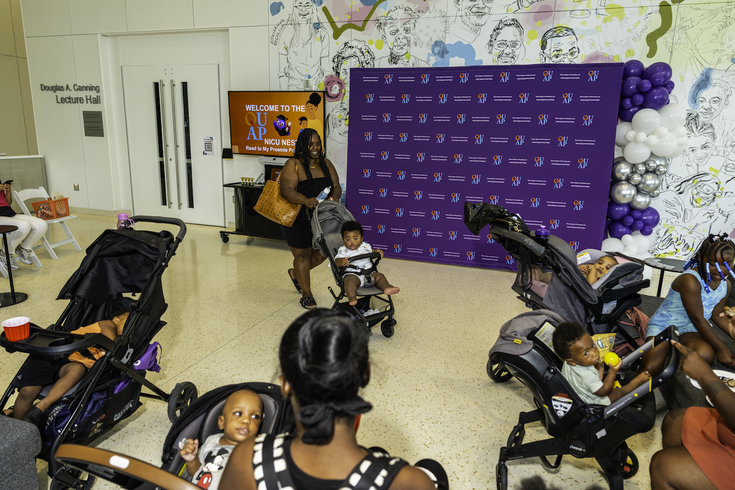
The NICU Nest program aims to support families of preterm babies and boost early literacy through in-person educational workshops. Every family leaves with care packages, including 10 free books to help build their at-home libraries.
"We know that babies who are read to develop language faster and develop a wider vocabulary," Montoya-Williams said. "We know that preterm babies respond to their parents' voices, so all of this is still grounded in the science of preterm brain development. But it also, I think, can pay such dividends to parental mental well-being."
Johns agreed.
The NICU Nest program offers "virtual support for preemie families who are still bedside with their babies, so that they can still receive the encouragement and the education to read and bond with their babies, and also receive some emotional and mental support," said Johns, who lives in Philadelphia.
Books and reading are also tools that help parents of babies in the NICU "normalize their parenthood journey," Johns said.
Having a baby admitted to the NICU can be a "stressful, anxiety-producing and sometimes even traumatic experience that just so disrupts the vision of what early parenthood should be about, and even just what the days are supposed to look like, and parents' own feelings and views about what they're supposed to be doing," Montoya-Williams said.
One of the NICU Nest program's "biggest contributions" is creating a community within an experience that otherwise "can feel so isolating and so scary to navigate on one's own," Montoya-Williams said.
The early literacy program also can help "set the stage for a routine that can be continued once the baby is discharged and comes home," Johns said.
Having been encouraged to read to Tochi when he was in the NICU, Johns and her son still sometimes cuddle up at night and read books together, she said.
"For me, as a parent, it's been amazing to see how those early seeds that we deposited way back when in the NICU are showing up academically, because once he learned how to read, he's been reading above grade level ever since," Johns said.