




September 22, 2026
 SEPTA/Provided Image
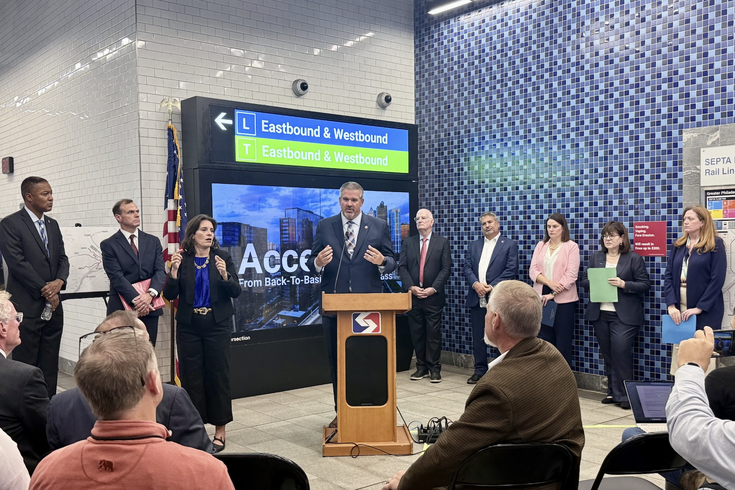
SEPTA General Manager Scott Sauer on Tuesday revealed the authority's 'Accelerate' plan, which lays out its potential if it received long-term investments.
SEPTA officials on Tuesday painted a rosy picture of what the transit authority could be if it received long-term investments, with more frequent Regional Rail service, station improvements, new subway cars and system-wide accessibility upgrades.
The ambitious vision was part of the new "Accelerate" plan, which features more optimistic messaging than the "doomsday" scenarios that have been presented in the past. General Manager Scott Sauer hopes that the change in tone will resonate better with lawmakers who have consistently failed to approve a steady stream of funding for the state's largest public transportation system.
"What we're putting forward here is what we've been asked to do by a lot of folks: 'Outline for us what that investment is going to get us,'" Sauer said. "This is what it takes to move to a best-in-class transit system where it's useful to everyone and becomes more of an economic engine than it already is."
At the behest of potential investors, the plan consists of a four-pronged approach — trolley modernization, new vehicles, Regional Rail upgrades and a new bus network — some of which has already begun to be implemented.
"Accelerate" lays out a Regional Rail Master Plan to be implemented by 2050 that aims to establish a new "S Tier" of regional lines that arrive every 15 minutes or sooner. These include certain sections of Fox Chase, Airport, Wawa, Paoli, Norristown and Chestnut Hill East lines. Others would operate every 30 or 60 minutes, but they better align with local bus and metro routes.
The plan also calls for more frequent service to the T, G and D trolley lines and replacing the 40-year-old fleet with vehicles that contain wider doors and more spacious interiors.
State funding is required to purchase a new fleet of Market-Frankford Line cars, which are expected to arrive in 2029, and could also be used to acquire new vehicles for the Broad Street Line and Norristown High Speed Line, officials said.
SEPTA highlighted its New Bus Network Initiative, which introduces new bus routes, extends and realigns others and introduces three "SEPTA Go Zones," an on-demand ride-share service in the suburbs. The outline includes modernization projects for bus, Regional Rail and trolley stations that include better lighting, shelter, seating, modern wayfinding signage and real-time departure information.
Under the plan, officials estimated that over 2 million people would live within a quarter mile of frequent transit, up from 900,000 today. It would also put nearly half of the region's jobs within a quarter mile of frequent transit, compared with around 1 in 4 jobs today, and 100% of trips would go through an accessible station, an improvement from around 60% today.
Sauer did not disclose a final cost or timeline for implementing this strategy, instead emphasizing that the authority is continuing to focus on securing stable, dedicated funding that can be counted on every year. SEPTA currently has a $192 million operating budget deficit, he said.
"We want to run more frequent service," he said. "I want to work with everyone to find out what the number is to make the vision a reality and how quickly we want to get there. … It's a matter of are we going to get there in 50 years, 25 years or 10 years?"
Some elements of the plan, such as accessibility upgrades at three Center City trolley stations and 11th Street Station, are already in motion. But other aspects, like the full vehicle replacement program, Trolley Modernization Plan and Regional Rail Master Plan, will require more support from SEPTA's partners, Sauer said.
After lawmakers in Harrisburg failed to find a recurring source of funding for SEPTA last year, the authority was forced to implement sweeping service cuts and fare hikes. The service cuts were eventually blocked by a judge.
Sauer requested the Pennsylvania Department of Transportation to use around $400 million in capital funding to supplement its operational needs, although he called the proposal a "Band-Aid" for the authority's sizable deficit. The funding is slated to run out by the beginning of the next fiscal year on July 1, 2027.
"Lawmakers last year wanted us to get our house in order," Sauer said. "Get safer, get cleaner, get more reliable and I believe we've done that. …We're doing all we can with what we have. But look at what we can do with the proper and stable investment in transit."