





October 20, 2026

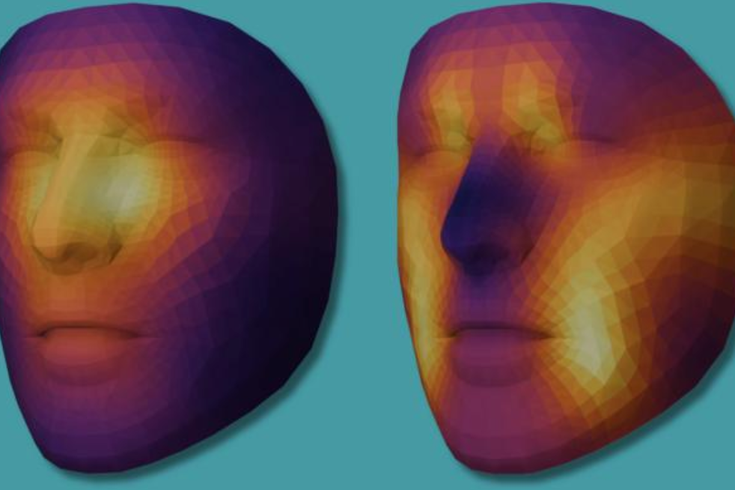 Mass General Brigham/Lancet Digital Health
Researchers at Mass General Brigham in Boston have developed two AI models that can estimate biological age and predict cancer survival outcomes from a single face photo. The left image shows the features most important to to predicting cancer survival. The right image shows the features most important for predicting biological age.
Researchers are figuring out how to use artificial intelligence to determine a person's cancer survival outcomes from a single facial image.
Researchers from Mass General Brigham in Boston developed a large AI foundation model trained on more than 40 million facial images, called FAHR-Face, short for Foundation Artificial Intelligence for Health Recognition.
An earlier version of the model, FAHR-FaceAge, predicted a person's biological age — the extent of a body's aging at a cellular level rather than a person's age based on chronological years. The new findings, published Monday in the Lancet Digital Health, presented a more accurate version of this model.
The researchers also trained a second, finely tuned version of the model, FAHR FaceSurvival, on 34,000 facial images of people with cancer. FaceSurvival was able to predict a person's chances of surviving cancer, essentially from one selfie.
"FAHR-FaceSurvival advances the field of facial health recognition AI a step further by learning survival risk directly from facial photographs of patients with cancer," Hugo Aerts, the study's co-senior author, said in a news release. "To our knowledge, this is the first demonstration that an AI model can directly predict cancer survival from a simple photograph."
Aerts is also the director of Artificial Intelligence in Medicine at Mass General Brigham.
FaceSurvival predicted cancer survival based on facial features, such as creases running from the nose to the mouth and around the eyes. Roughly half of cancer patients with FaceSurvival scores in the highest 10% died within three months. About 2% of patients with scores in the lowest 10% died within 90 days.
The researchers also found that people who had a biological age above their age in chronological years were more likely to have worse cancer outcomes.
"As the population ages, physicians need better ways to estimate physical reserve and frailty before recommending intensive treatments such as radiation, surgery or systemic therapy," Dr. Raymond Mak, a radiation oncologist at Mass General Brigham Cancer Institute said in the news release. "Our goal is to make face photograph-based health assessment more quantitative, consistent and scalable so it can support personalized treatment decisions rather than replace physician judgment."
Lifestyle factors, such as smoking and drug use, affected facial features, making people look older in photos, the researchers said. But precisely how AI determines biological age and cancer outcomes from facial images is not fully understood.
"One of the fascinating unanswered questions is what exactly the algorithm is seeing," Suchi Saria, director of the John Hopkins University Machine Learning and Healthcare Lab, who was not involved in the study, told the Washington Post. "But we don't yet know what physiological features in those regions are carrying the signal. Understanding that would help us determine whether the model is discovering a genuinely new biomarker or quantifying visible manifestations of illness that clinicians already recognize."
Emma Pierson, an assistant professor of computer science and core faculty at the University of California, Berkeley, told the Washington Post that she was concerned about the model's potential racial bias.
"Any time you train something on someone's face, you are implicitly including patient race in the model's predictions," said Pierson, who was not involved in the research.
Due to historical disparities in access to quality health care among different racial groups, health outcomes vary. Training AI on faces could be "encoding racial bias into your model," Pierson said.