



June 16, 2026
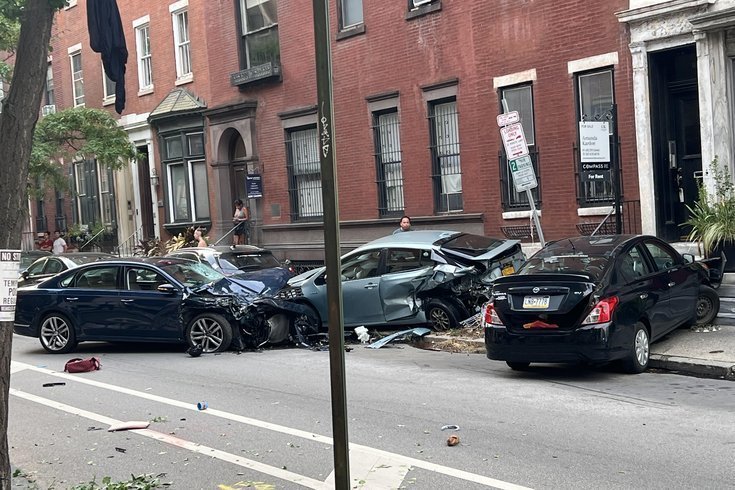 SHARPONEPHILLY/REDDIT
CHOP physician Barbara Friedes, 30, was killed in July 2024 when a drunk driver struck her bike from behind as she rode in the bike lane on the 1800 block of Spruce Street in Center City. Friedes' family is now suing the driver, 70-year-old Michael Vahey, who was sentenced last year to serve six to 20 years in prison. Above, a photo from the aftermath of the crash.
The family of Barbara Friedes has filed a wrongful death lawsuit against the drunk driver that fatally struck her as she was bicycling on Spruce Street in Center City two years ago.
The suit, filed Monday in the Philadelphia Court of Common Pleas, seeks more than $50,000 in damages from Michael Vahey, 70, who was sentenced to six to 20 years in prison after he pleaded guilty to third-degree murder and related charges last year.
MORE: New protections for bicyclists added to 13th Street in Center City
Friedes was a 30-year-old physician at the Children's Hospital of Philadelphia. Her death has been a focal point of cycling advocates seeking better bike lane protections in Philadelphia, including calls for concrete barriers separating cyclists from drivers on Spruce and Pine streets in Center City.
Vahey had a blood-alcohol concentration more than twice the legal limit and was speeding when his Volkswagen swerved into the bike lane on the 1800 block of Spruce Street on July 17, 2024, authorities said. Vahey was attempting to get around other cars at 7 p.m., when it was still light outside. He struck Friedes from behind at 57 mph. Friedes' body was recovered 150 feet from where the collision occurred, according to investigators.
Video evidence shows Vahey ran over multiple plastic bike lane dividers, crashed into several parked cars and nearly struck a pedestrian, prosecutors said.
The family's lawsuit, which includes counts of negligence and wrongful death, was filed by Center City personal injury law firm Kline & Specter.
"Vahey was operating his vehicle at an outrageous speed when he entered the designed bike lane where Dr. Friedes was lawfully riding her bicycle," the suit says. "His foot never left the accelerator of his car as he struck Barbara, who was suddenly and violently catapulted into the air."
Friedes experienced "conscious pain and suffering" before she died, the suit says, and her injuries included skull, rib and spinal fractures.
Friedes was a third-year pediatric resident at CHOP who earned her medical degree from Johns Hopkins University's School of Medicine. During her time in CHOP's pediatric program, Friedes was awarded for her work and courage among residents in her unit.
In the aftermath of Freides' death, Philly Bike Action and other cycling advocacy organizations held demonstrations demanding the city take steps to improve bike infrastructure. In December 2024, the city passed the "Get Out the Bike Lane" law banning cars from parking or temporarily stopping in paths designated for cyclists. The law increased fines for violators and eliminated a grace period for spot enforcement by the Philadelphia Parking Authority.
Last October, the city also passed a law that formally allows the Streets Department to use street parking spaces for temporary loading zones where drivers can stop instead of illegally using bike lanes. The city installed temporary loading zones on Spruce and Pine streets, including the area where Friedes was killed, but residents filed a lawsuit that resulted in a court order to remove the loading zones. That case remains unresolved after a hearing earlier this month ended with a judge's decision not to rule from the bench. A date for a future decision has not been determined.
Although the case places a temporary injunction on new loading zones, it does not prevent upgrades to bike lane infrastructure. The city received $27 million in state grants earlier this year for a range of transportation safety projects, including $5 million for bike lane upgrades. PennDOT, which distributed the grants using money from red light camera violations, noted that planned improvements include upgrading existing bike lanes with concrete curb separation.
At a budget hearing for the Streets Department earlier this year, an attorney for the city said a project to add concrete curb separation to the bike lanes on Spruce and Pine streets is delayed due to pending litigation.
Philly Bike Action spokesperson Jessie Amadio said Tuesday the city is being overly cautious.
"Unfortunately this lawsuit has created a major delay to life-saving safety improvements," Amadio said. "Hopefully the case is decided quickly and the project can go ahead before another person is killed."
Amadio noted the November 2017 crash that killed 24-year-old Emily Fredericks, a pastry chef who was struck and killed by a private sanitation truck that hit her as the driver turned onto Spruce Street from 11th Street.
Fredricks' family reached a $6 million settlement in 2018 with Gold Medal Environmental, the private sanitation company whose truck hit Fredericks. The company also agreed to donate $25,000 per year over a five-year period to support road safety projects in Philadelphia.
"Protected bike lanes and loading zones on Spruce and Pine have widespread support from residents, businesses and city leaders," Amadio said.
In March and April, Philly Bike Action held demonstrations along Spruce and Pine streets to show what concrete curb separators might look like. The group said it expects the city's most likely solution will be to install small concrete barriers with gaps in between them to maintain pedestrian access.
"Not everybody's a biker, but I think almost everybody prioritizes safety," Caleb Holtmeyer ,a District 1 organizer with Philly Bike Action, said in April. "I think for a lot of people, they've seen the crashes that happen or they've lost somebody to a car crash. And I think there's a major desire for safety, whether or not someone walks, bikes, drives. I think people want to see a safer street."