




August 17, 2026
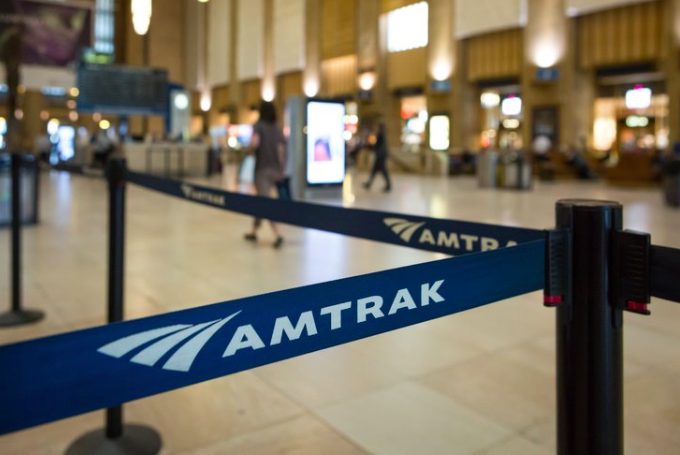 Thom Carroll/for PhillyVoice
The Schuylkill River Passenger Rail Authority and Amtrak have a memorandum of understanding to plan and develop a service that runs between Reading and Philadelphia, with stops in Pottstown and Phoenixville. The corridor has not had passenger rail service since 1981.
The Schuylkill River Passenger Rail Authority hit a pivotal milestone last month when the regional agency reached an agreement with Amtrak to operate the future service between Reading, Pottstown, Phoenixville and Philadelphia.
For the first time in more than four decades, a federally backed plan will restore rail service along the river corridor that passes through Berks, Chester and Montgomery counties. SEPTA operated service to Reading until 1981, when the line was cut amid financial strain, declining ridership and growing reliance on cars.
"Like so many passenger rail services, the day after it was discontinued, people were asking how can we get it back?" said Tom Frawley, SRPRA's executive director.
Past efforts to revive the passenger line have been overly ambitious and cost prohibitive. In the early 2000s, the proposed Schuylkill Valley Metro envisioned a high-frequency service with 34 stations running from Philadelphia to Reading. It was expected to cost more than $2 billion and carry an estimated 49,500 weekday riders. The Federal Transit Administration rejected the plan, citing its high capital costs and complexity for a project that lacked local financial commitments.
In the years since then, populations in Reading and Phoenixville have grown. The long-term contraction of Pottstown's manufacturing sector has kept residential growth there flat, partly due to the borough's disconnection from Philadelphia compared to other remote slices of the metro area. Bus service, the corridor's primary mode of transit, is offered by the South Central Pennsylvania Transportation Authority, which consolidated the Berks Area Regional Transportation Authority and Lancaster County's Red Rose Transit Authority.
The absence of passenger rail has taken a toll on roads as more people flock to communities on the banks of the Schuylkill River, places that Frawley says have "good bones" despite their limited transit service.
"It's kind of like a wave moving its way up the corridor," Frawley said. "In Phoenixville, if you look at the number of housing units that have been built in the last five years, it's staggering. The big challenge — and you'll hear it from everybody who lives there — is, 'Oh my God, the traffic is terrible. I can't get in or out.'"
The memorandum of understanding between SRPRA and Amtrak appears to be a solid bet that passenger train service will be restored along freight corridors owned by Norfolk Southern. Some of CSX's tracks may also be used en route to Philadelphia, and there's a possibility a portion of the line would connect with SEPTA's network in Norristown on the east side of the river.
Momentum for the startup service picked up in 2023 when the Federal Railroad Administration selected SRPRA among 69 national rail corridors that would receive grant funding for planning and development. SRPRA is in a smaller group of about 40 that the agency considers "ready for prime time," Frawley said.
"We have been assured by our friends with the FRA that we are in that select group for a variety of reasons, not the least of which are relative ease and speed of implementation and relatively low cost," Frawley said. "And there is a relatively high probability of success in terms of riders."
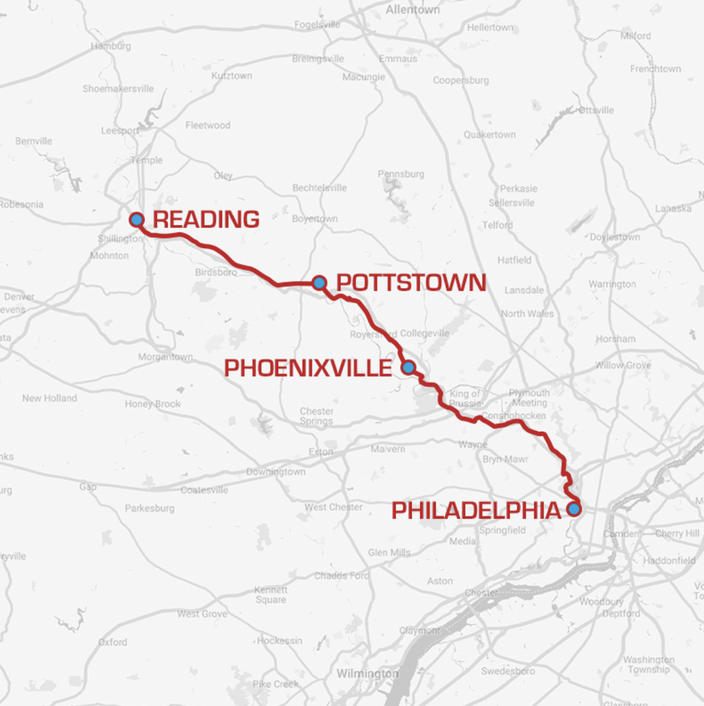
A map shows the proposed route for the Schuylkill River Passenger Rail Authority.
The most optimistic timeline would introduce service to the four core stops as early as 2030. Trains would run between Reading's historic Franklin Street Station, the two dormant stations in Pottstown and Phoenixville, and 30th Street Station in Philadelphia. Renovations will need to be locally funded, but Frawley said much of the rail infrastructure costs will be subsidized by the federal government. Most of the corridor is already equipped with Positive Train Control, the satellite-based safety system that's federally mandated for passenger lines.
Frawley said a ballpark estimate puts the project's rail component around $100 million.
"We have very high-quality infrastructure," he said. "The Reading Railroad built a good railroad, and Norfolk Southern has continued to maintain a good railroad signal. It's a double-track railroad for most of the way, signaled in both directions on both tracks, which gives you a lot of flexibility in terms of how you route trains. Flexibility tends to lead to efficiency."
Amtrak is still developing estimates for ridership and other variables that will be presented in a report that's expected to be released later this year. Frawley said SRPRA would likely rely on a combination of federal, state and county operating subsidies until the service matures to forecasted ridership. The model could be similar to Amtrak's Keystone Service that PennDOT supports between Harrisburg, Philadelphia and New York City.
"In terms of value for money, I think if we get thousands of people a day on average taking the train — when we're up to seven or eight trains a day each way — that's a success story that's going to create a lot of economic benefit throughout the region," Frawley said.
At a time when SEPTA's funding crisis has pushed Regional Rail to the brink in recent years, SRPRA is a welcome sign of progress for passenger rail. Frawley thinks there are lessons to be learned from SEPTA's challenges and how it has been adapting to better serve a broader segment of riders.
"As service patterns evolve to be less of a strictly 9-to-5 commutation pattern and more of an easy way to get from here to there, no matter when it is during the course of the day, I'm hoping performance improves," Frawley said. "I know that people at SEPTA are working hard to make that happen."
The rise of remote work during the COVID-19 pandemic gutted ridership for many public transit agencies, forcing them to rethink schedules and the reasons people choose to take a train. The federal government's support of SRPRA and other untapped rail corridors reflects a push to capture demand for intercity travel — whether it's for work or recreation — from morning into night seven days a week. The infrastructure is already in place and many passenger trains can operate at speeds up to 80 mph on existing tracks.
"Intercity rail, like commuter rail, can coexist with freight trains," Frawley said.
In the long run, SRPRA envisions linking and blending its service with other Amtrak lines to reach more destinations. Some trips could continue beyond Reading into New York, or go past Philadelphia and continue south to Washington, D.C. Others would only require a simple transfer.
"If I were in Phoenixville, but I had a business meeting in New York, and I could get there efficiently either by connecting at 30th Street or by a one-seat ride all the way to New York, there's a lot of potential here," Frawley said. "If I'm from Pottstown, and I'm going to a conference in Washington, and I get to 30th Street, and I transfer to a train south, I can get to get there in a reasonable amount of time at a reasonable cost."
There are key details SRPRA and Amtrak will need to figure out in the coming years, including track arrangements with Norfolk Southern and potentially CSX. The rail's passage along the Schuylkill River also will pose challenges for some riders who may not live nearby bridges to cross and reach stations. The overall timeline for the project will be contingent on the delivery of Amtrak's Airo trains that were ordered from Siemens a few years ago. The first trains are now in testing and could be introduced to passenger service in the Pacific Northwest later this year.
"They can be configured either to run just as a diesel train, or just as an electric train, or as a dual-powered train, where it can run as an electric train when it's under wire, and if it needs to venture out to non-electrified territory, can run as a diesel itself," Frawley said.
In a post-COVID world, services like SRPRA may help answer questions about demand for passenger rail and the most efficient ways to operate a flexible, sustainable service.
"Everyone's trying to get their heads around this," Frawley said. "What is employment in the middle of town in the big city going to look like relative to its surrounding region, and where is that trend over time? There are interesting things going on there in terms of the social sciences and economics. There's always going to be a place for fixed routes, be it rail or bus."