


October 02, 2026
 aajdesign/for PhillyVoice
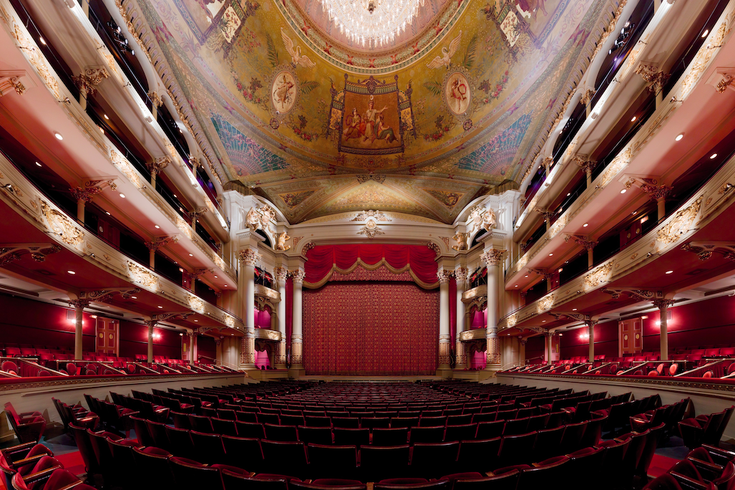
The first motion picture for a live audience was displayed at Philadelphia's Academy of Music in 1870.
Over two decades before the first paid movie screening took place in Paris in 1895, a Philadelphia-based chemist and inventor showed off his "phasmatrope" invention at the Academy of Music that paved the way for the future of motion pictures.
To give the illusion of a moving image, Henry Heyl attached multiple photographs to a "skeleton wheel" with 18 slits that rotated using a manual crank, which switched between the slightly differing images. When projected with a bright lantern, the photos — which were printed on glass slides — appeared to come to life.
On Feb. 5, 1870, Heyl presented his invention to a crowd of 1,500 people who weren't aware of what they were about to see, said Andrew Greenblatt, CEO of Philadelphia Film Society.
"It stunned everybody," he said. "If you've never seen anything move on video and then all of a sudden you do, that's revolutionary."
He showed three motion pictures — one on a popular Japanese acrobat, another that debuted a character known as Brother Jonathan, who was voiced by an actor behind the screen, and a sequence of photos of Heyl waltzing with one of his relatives that was timed to a live orchestra.
A program for the exhibition said the invention was meant to emulate "graceful and lifelike" movements on the screen, the Evening Public Ledger reported in 1919.
"This instrument is designed to become the most valuable auxiliary to the appliances for illustration," the program said. "We have the pleasure of having the first opportunity of presenting its merits to an audience."
Operating at just three frames per second, the invention was a far cry from today's movies, which are typically played at 24 frames per second. But the invention undoubtedly set a foundation for what the film industry would become. Heyl exhibited the phasmatrope once more for another audience at the Franklin Institute the following month, the Evening Public Ledger reported, but he never returned to the filmmaking industry after.
"Had Mr. Heyl placed his claim before the patent authorities as late as 1805, he would now be receiving a royalty on every foot of film produced," the outlet wrote in 1914. "But as he did not, he now says the laugh is on him and he enjoys it."
But his inventions didn't stop there. Heyl went on to create the first foldable paper box for delivering milk as well as a wire-stitching machine for sewing books together, which became better known as the first stapler.
"Filmmaking jumped to a certain extent from Philadelphia to France, where the Lumiere brothers started working on film," Greenblatt said. "(Heyl) solved what he wanted to solve and then came up with another thing. ... But you have to imagine they took note from him. This was revolutionary."
Heyl served as a director for the Franklin Institute for over three decades leading up to his death in 1919, when he fell off a trolley car at Broad and Walnut streets.
The first public showing of a motion picture is one of five firsts that will be recognized as part of the Philadelphia Historic District 250th Committee's yearlong "52 Weeks of Firsts" program. Every Saturday, a different person, invention or significant contribution with roots in the city is being honored with its own "Firstival" from 11 a.m. to 1 p.m. Each event includes family activities, giveaways, live music, entertainment and stories told by Once Upon A Nation actors.
The Philadelphia Film Society Center will host a firstival event at 1412 Chestnut St. during the annual Philadelphia Film Festival on Saturday, Oct. 24.
Here are the four other firsts being celebrated this month:
• First Penitentiary in America (1829): Eastern State Penitentiary housed some of the world's most notorious criminals and also served as a starting point for early justice reform in the United States. The penitentiary at 2027 Fairmount Ave. will host an event on Oct. 3.
• First Peoples: Some of the country's first inhabitants were indigenous members of the Lenni-Lenape tribe, which had deep roots along the Delaware River. Penn Museum at 3260 South St. will educate guests about them on Oct. 10.
• First U.S. Navy & Marine Corps (1775): One year before the Declaration of Independence was signed, the Continental Congress gathered at Independence Hall to authorize the creation of the first naval fleet and marine branch. A firstival will be held at the Arch Street Meeting House at 320 Arch St., where the first commandant of the marine corps is buried, on Oct. 17.
• First Modern Detective Story Written (1841): Before Sir Arthur Conan Doyle penned the iconic "Sherlock Holmes" series, Edgar Allan Poe originated the blueprint for how a modern detective thriller is structured with "The Murders in the Rue Morgue," which was written in Philadelphia. The Edgar Allan Poe National Historic Site at 532 N. 7th St. will host an event dedicated to the book on Oct. 31.
A full list of the firsts being celebrated this year can be found on Visit Philadelphia's website.