




April 15, 2026
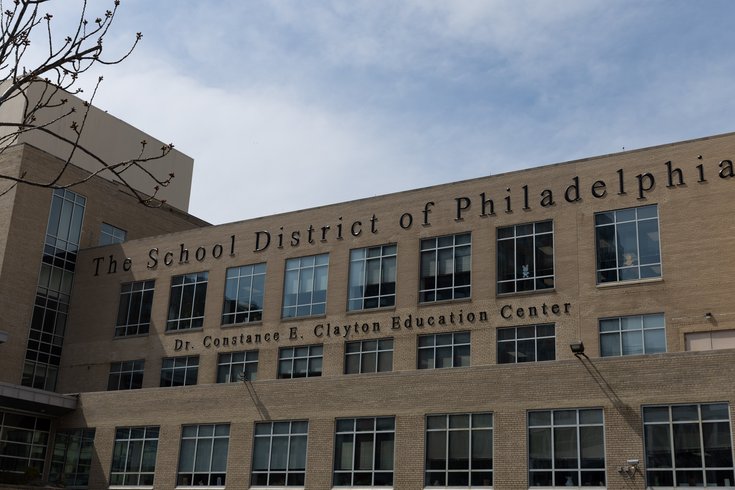 Colleen Claggett/for PhillyVoice
Mayor Cherelle Parker said her proposal to add a $1 tax to rideshare transactions in the city would help the School District of Philadelphia retain all 340 jobs it had planned to eliminate.
Uber and Mayor Cherelle Parker exchanged barbs over her proposal to add a $1 tax to all rideshare transactions in Philadelphia, with the tech company launching an ad campaign and calling the fee a “regressive double tax” that will decrease drivers’ earnings.
Parker defended her plan during a news conference at City Hall on Wednesday in which she announced that the funds raised from the tax would be used to help the School District of Philadelphia retain all 340 jobs it had planned to eliminate.
MORE: Free Library completely restores Saturday hours for first time since before the pandemic
“My revenue proposal is not a tax on drivers,” Parker said. “... I don’t own a big tech company like some of those that you are hearing messages from. I’m telling you it’s inaccurate. Those are not the facts.”
Parker made references to the rhetoric used in several in-app notices and videos Uber released in opposition to the tax. The company has claimed the proposal will disproportionately impact seniors and people in underserved areas, and it estimated that drivers' earnings would decrease by around 4.5%.
Parker has said tech companies like Uber and Lyft can foot the bill, but both transportation services have remained steadfast that riders will be responsible for the charge. Uber also said that since it's already beholden to a Transportation Network Company (TNC) fee that pays 1.4% of all fares to the Philadelphia Parking Authority, the plan effectively taxes riders twice.
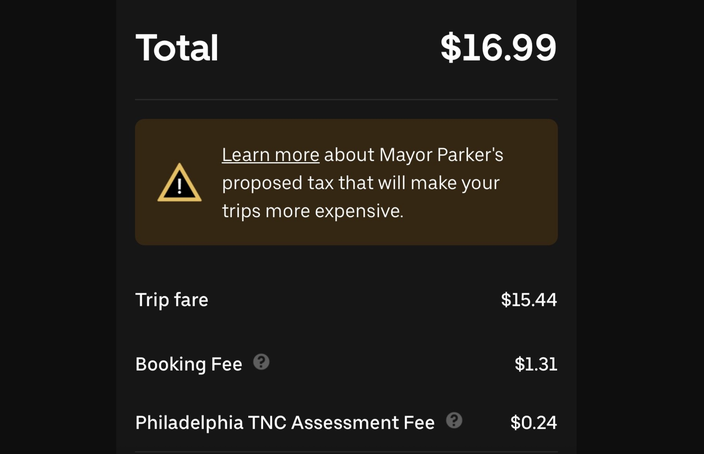
The Philadelphia TNC Assessment Fee and an alert that reads “Learn more about Mayor Parker’s proposed tax that will make your trips more expensive” are highlighted on Uber receipts. The company has spent six-figures on ads to blast Parker's plan, WHYY reported.
Uber has begun displaying in-app notices alerting users to a rideshare tax proposed by Mayor Cherelle Parker.
“Everywhere in the world, rideshare taxes are consumer taxes paid by riders — raising prices, reducing demand, and ultimately lowering driver earnings,” Jazmin Kay, public affairs associate at Uber, said in a statement Wednesday. “In a moment of real affordability strain, adding a new $1 fee on top of the existing 1.4% rideshare fee creates a regressive double tax that will limit access to work, school, and essential services even as thousands of jurisdictions across the country choose not to tax rideshare at all.”
Parker pushed back on Uber’s implications that Philadelphia is one of a limited number of governments that regulate rideshare services.
“When you read the ads and listen to what you hear on different platforms, you would think that the city of Philadelphia is the first in the entire nation to propose a rideshare tax,” she said. “San Francisco, the home of Uber and Lyft, has a rideshare tax. …We’re in local government. Our job is to do the best we can with the limited resources that we have.”
As part of Parker’s $6.97 billion budget proposal, the rideshare tax is estimated to generate around $48 million per year. Those funds would be used to cut into the School District of Philadelphia’s $300 million budget deficit.
While initially saying the tax would help prevent some layoffs of classroom jobs, Parker on Wednesday said the city’s finance team was able to “make adjustments” to allow for every school-based position to be retained using revenue from the plan.
“That is tremendous news, I believe, for our children, their parents, for every teacher and all of our school district employees,” she said. “That is something for us to be proud of … if we can actually make it a reality.”