



May 19, 2026
 Leo Manning/Center City District
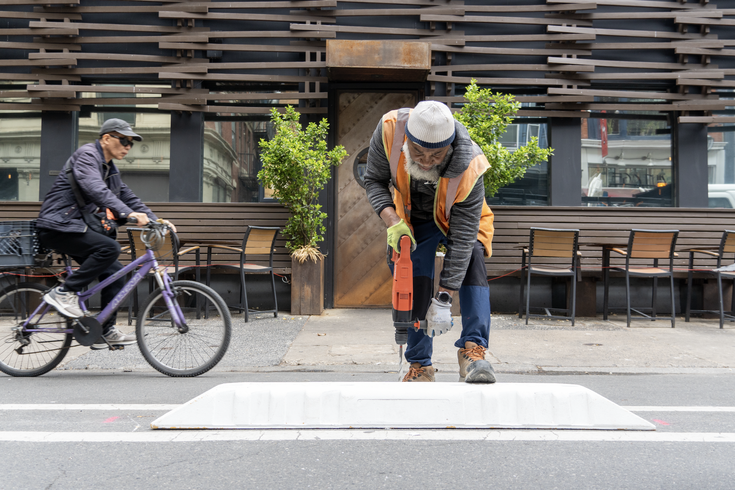
Modulator posts — small, plastic barriers that separate bicyclists from motorists — have been added to 13th Street between Locust and Chestnut streets. It's one of Center City's busiest corridors.
New bicycle safety protections have been added to the bike lane on one of Center City's busiest roads.
Delineator posts have been installed on 13th Street between Locust and Wood streets, and potential hazardous zones have been painted green. Also, 18 modular curbs — small, plastic barriers that separate bicyclists from motorists — have been added between Locust and Chestnut streets.
MORE: Gas prices are rising, but not enough to reduce Memorial Day weekend traffic
The modular curbs were donated by the Center City District.
"Mexico City used protected lane separators like these to build over 150 miles of safer bike infrastructure and we're proud to donate 18 to pilot that same approach here," CCD President and CEO Prema Katari Gupta said in a statement. "It's a low-cost way to create a safer, more accessible downtown that works for cyclists and businesses alike."
Leo Manning, the CCD's director of strategic communications, said the curbs' effectiveness will be evaluated before others are potentially put in place at other busy roads in the city.
13th Street is one of the most busiest corridors for cyclists. Its intersection with Pine Street averaged 255 cyclists per hour in 2025 — one of the highest bike counts in the city, according to data from the Bicycle Coalition of Greater Philadelphia.
The installation of a buffered bike lane along North 13th Street last year led to an increase in cyclist traffic on the road, the Bicycle Coalition found.
"The updates along the 13th Street bike lane will make this critical downtown corridor safer for everyone," Kelley Yemen, director of the city's Office of Multimodal Planning, said in a statement.
The upgrades play into the city's Vision Zero goal, which aims to eliminate all traffic deaths in Philadelphia in part by installing safety improvements along the city's most dangerous roadways.
The upgraded section of 13th Street is not a part of the city's High Injury Network — a group of roads that account for 80% of the city's traffic deaths — but Yemen called the improvements "essential" to creating safer streets.
Cycling advocates have called for similar measures to be permanently installed on other corridors, including Spruce and Pine streets, which have attracted increased focus since the death of Barbara Friedes, the Children's Hospital of Philadelphia doctor who was fatally struck by a drunk driver while cycling on Spruce Street in 2024.
In February, PennDOT awarded the city $1 million to install "No Stopping" signs along the bike lanes in the Pine-Spruce corridor. Bicycle advocates also are engaged in a legal battle to add loading zones there. A judge ruled against their addition last year after a group of residents filed suit. The case is ongoing.
Last month, members of the advocacy group Philly Bike Action laid traffic cones and modular curbs near the Kimmel Center between 10 a.m. and 1 p.m. as a demonstration to what stronger city-wide bike lane protections might look like.
"I think there's a major desire for safety, whether or not someone walks, bikes, drives," Caleb Holtmeyer, an organizer with Philly Bike Action said last month. "I think people want to see a safer street."