



May 18, 2026
 Michael Tanenbaum/PhillyVoice
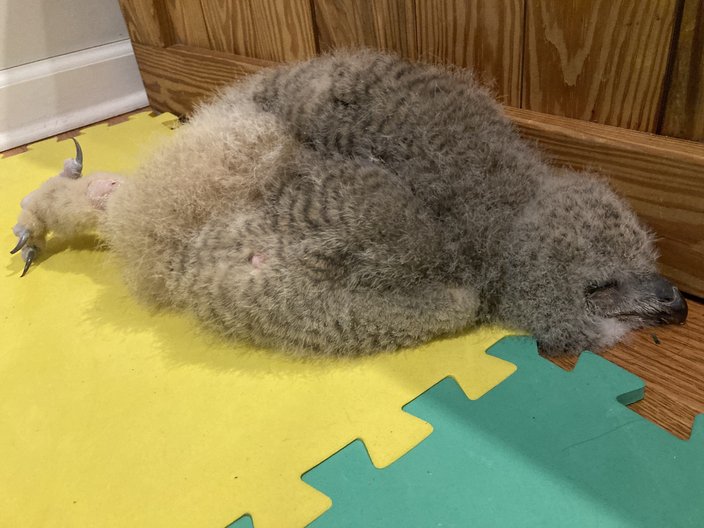
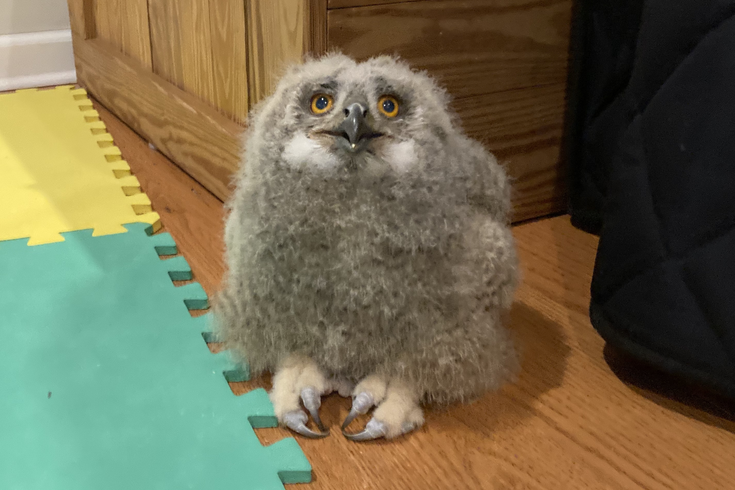
Medusa, a baby Eurasian eagle owl, is the latest bird to join West Philadelphia falconer Courtney Down's Raptor Jawn menagerie. The bird will be trained for educational events including meet-and-greets and flight demonstrations.
It's not a Muppet, a Furby or one of Steven Spielberg's mischievous gremlins. The fuzzy creature dwelling at Courtney Douds' home in West Philly is a Eurasian eagle owl chick being raised to one day alight on your forearm or bear your wedding ring at the altar.
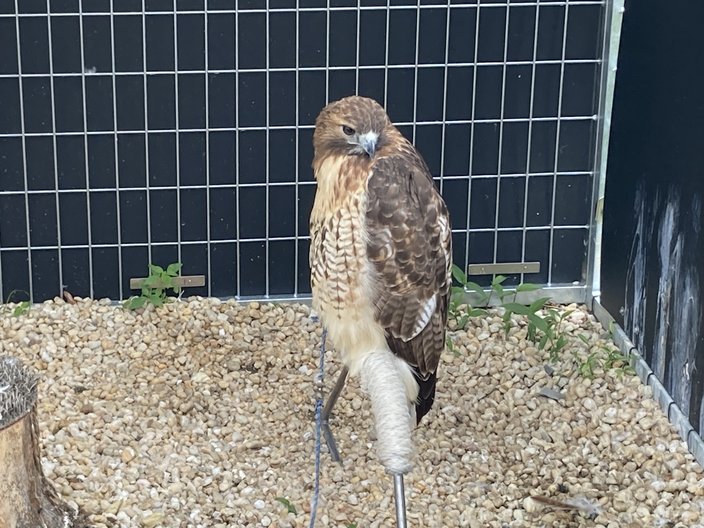
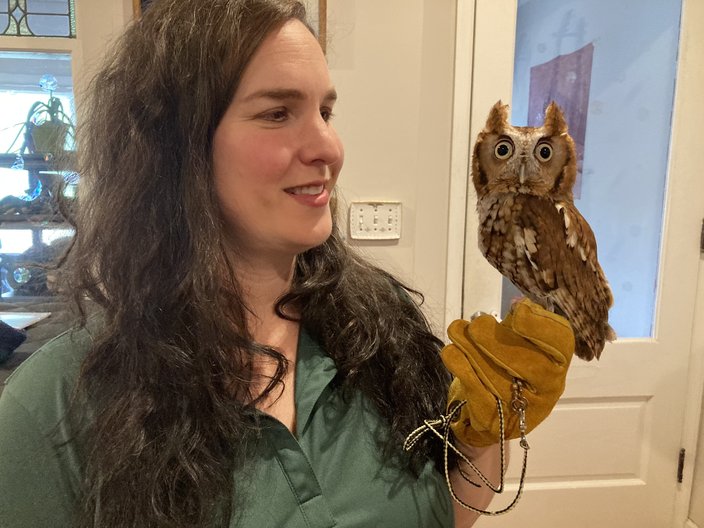
Douds is a master falconer and owner of Raptor Jawns, a bird education program that holds flight demonstrations and educational sessions at schools, birthday parties and public events. A red-tailed hawk, Medea, lives in Douds' backyard aviary. Hecate, an eastern screech owl, greets guests who enter Douds' home from a cage inside the foyer.
"As far as I know, I'm the only game in town — at least this locally," Douds, 37, said of her unusual line of work, which is allowed in Philadelphia as long the birds' care is state-regulated and routinely inspected by a game warden.
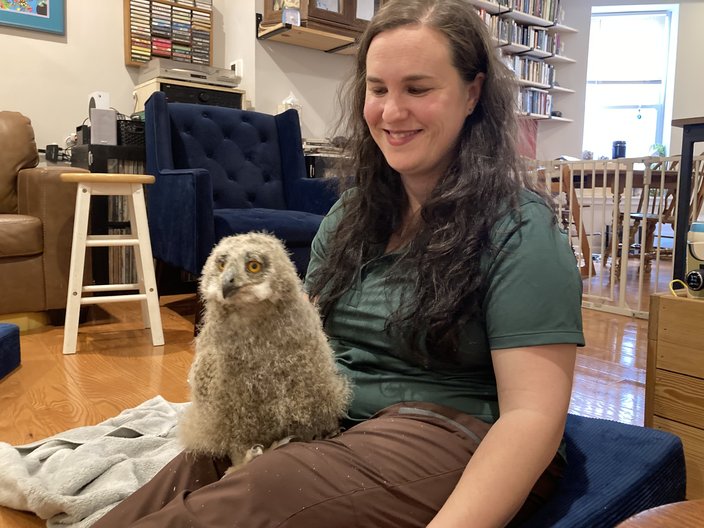
The newest addition to the Raptor Jawns family is Medusa, a 1-month-old, captive-bred owl Douds acquired from a breeder in upstate New York. Raising a non-native species from the time it hatches gives Douds greater flexibility for hands-on programs with the public. Activities with her other birds — both native species that were rescued — are limited by federal law.
At the home in Overbrook Park, where Douds lives with her husband Matt and their two young children, Medusa is now being "imprinted" by Douds to become fully acclimated to people. A mirror in the living room is covered with a blanket to keep her from seeing she's a puff ball of down feathers with a beak and sharp talons.
"She's not going to know that she's an owl," Douds said. "We want her to imprint on us and not herself. For a captive owl, it doesn't need to know that it's a bird at all. We really want her to think that she is human and we are all the same species."
Medusa had her first public outing Sunday night during a sold-out event at Love City Brewing's taproom in Callowhill. People who meet Medusa are invited to gingerly pet her and ask Douds questions about the species, which has a wide territory across Europe and Asia.
"They're kind of analogous to our great horned owl," Douds said. "They value privacy and secrecy and solitude so much. You want to get a captive owl young so that they are more comfortable with that working against their instincts."
In the wild, an owl like Medusa might live 20 years. In captivity, Medusa could live to be about 50.
"Her babyhood is a flash in the pan," Douds said. "It's possible I'll have to will this bird."
For now, Medusa weighs about 4 pounds. Beneath her down feathers, mottled brown and grey plumage designed for camouflage can be felt growing. At the tip of her beak, she still has a diamond-shaped egg tooth evolved to help her hatch. Medusa will grow to be about twice her current size, shedding all of her down feathers by the time she reaches 3 months. She has a steady diet of dead mice.
"In a week or two, she'll be hopping," Douds said. "We'll be feeding her to reinforce flights that we want and encouraging her to walk and hop to our glove."
Medusa is still getting her bearings with her body, much like an infant child. Her head and legs are heavy, making it hard to keep balance, and she frequently conks out for naps. She's begun to spread her wings, but won't be able to fly around until about 3 months.
At just over 1 month old, Medusa needs plenty of nap time.
When it comes to imprinting, nurturing and feeding are the name of the game.
"It's spending time with her. It's hand feeding her. It's taking her to a bunch of places around Philly so she acclimates to all the weird stuff she's going to see," Douds said. "And going at her pace. If she's looking stressed, back off. If she's chilling, keep it going."
Over the coming months, Douds is booking Medusa for private meet-and-greets at businesses and homes or at private locations in West Philly. Douds is already booked solid through June, but she's scheduling via email in July and beyond. Anyone under 16 must be accompanied by a parent or legal guardian.
Every bird has its own temperament. Sometimes Medusa chirps and clicks her beak, or she'll flare her mouth when she's a little spooked by noises. Her cries, at least for now, are not a cause for alarm.
"In an adult, it's a cranky 'f--- off' kind of noise," Douds said. "With a baby, it's excitement."
It's all part of making Medusa an owl of the people.
"They love a routine. They love a habit," Douds said. "This is what's expected of them. It's clear. They do it a thousand times and it becomes like clockwork for them."
Medea is an 8-year-old red-tailed hawk that Courtney Doud rescued. She's now an education bird for Raptor Jawns.
Douds grew up in Buffalo, New York, and knew she wanted to become a falconer around 12 years old, when she went to to see Wes Anderson's "The Royal Tenenbaums" in theater. Luke Wilson's character, Richie, owns a peregrine falcon named Mordecai.
"I sat my parents down and told them I wanted to start falconry," Douds recalled. "They were like ... 'What?'"
The ancient practice, originating in the Middle East, is centered on hunting wild game with a trained bird of prey. Douds started her journey by volunteering at a wildlife rehab, where she got experience working with barn owls and other birds of prey for a wildlife reintroduction program.
When Douds went to Columbia University in New York to study English and environmental biology, she got in touch with a falconry group on Long Island and learned how to hunt with birds of prey. Then she spent a year in Ireland after college to study at a falconry school.
"I worked at a castle flying hawks around the grounds as my first real job," she said.
Another gig Douds had in New Jersey involved flying hawks at a landfill for pest control. She went to South Carolina to obtain her federal falconry license, followed by a two-year apprenticeship, and then moved to Philly in 2019 to pursue a degree in social work from Widener University.
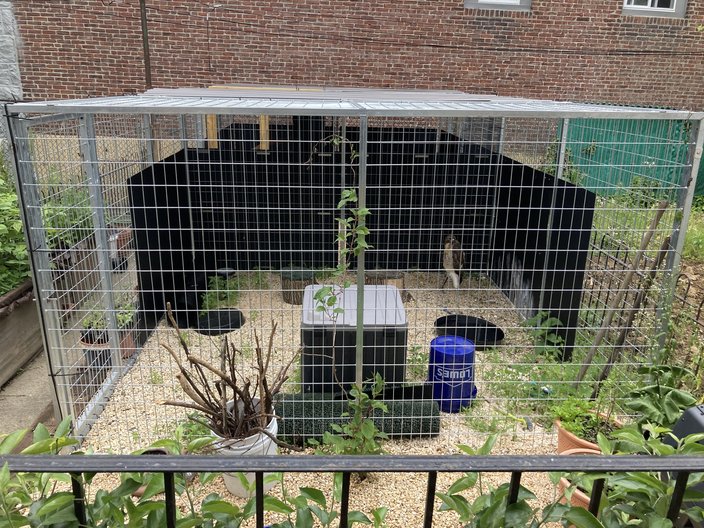
Douds now works as a therapist alongside her budding Raptor Jawns business, which got a Catalyst Fund grant from the city that enabled her to build a new outdoor enclosure for her birds. A permit from the Pennsylvania Game Commission allows Douds to have the enclosure. Medusa eventually will live outside in a section separate from Medea.
Raptor Jawns founder Courtney Doud has a bird enclosure in her backyard that she can keep with a permit from the Pennsylvania Game Commission.
For several years, Douds focused exclusively on trapping red-tailed hawks to train them for hunting on state game lands and other property. She would capture hawks in the springtime, using domed wire cages with a live mouse as a lure. When a bird would swoop in to clutch the mouse, a rope would trap its talon to keep it from escaping. The mouse gets to live.
"It's kind of like sky fishing," Douds said.
Falconers rely on a bird's food motivation to develop trust and hunt during the fall. Douds' hawks, usually kept one at a time, hunted all kinds of rodents and reptiles. The sport can be both delicate and ruthless. Many trained birds benefit from the experience, Douds said, by getting steady food sources that keep them healthy for their return to the wild.
"Falconry is such a risk-heavy hobby. You can lose your bird. Your bird can fly away. It can get killed by another bird. It can land on a power line and die," Douds said. "There's a ton of anxiety built into falconry. You have to deal with that."
When Douds started Raptor Jawns during the COVID-19 pandemic, acquiring Medea and Hecate, she decided to transition into bird education while raising her first child. It required a shift in the way she trained and engaged with her birds. She no longer has a hunting bird, for now.
"They're totally different aims between education and falconry," Douds said. "With falconry, you want a bird that's a badass, aggressive killer. For this, you want one that's well-adjusted and happy to just hang out with people."
As precious and lovable as Medusa is, her connection with Douds will be mostly transactional for the owl.
"They're not socially intelligent. I get to adore her and she tolerates me. Hopefully, I do a good enough job that I'm an asset to her," Douds said. "What I see in her is curiosity, apprehension and playfulness. I hesitate to put any positive emotional attribution to my birds. I just think so much of it is, 'You feed me, we're cool.' I find it freeing. There's no demand on this bird to love me or act a certain way."
Courtney Doud holds Medusa in her lap at her home in West Philly.
Some raptor species are more intimate with their trainers than others. Harris hawks, which are native to the United States, are pack animals that connect with humans when imprinted. Some birds can become flirty with their owners when they reach sexual maturity. Females might fluff up their vent feathers while males sometimes make alluring calls. All birds have a cloaca — a single opening they use for excretion and reproduction — that they "kiss" each other with to mate.
Douds has never had a bird come onto her like that — yet.
"Or I've been too dull to recognize the invitation," she said.
In August, Douds has plans to welcome another captive-bred bird — a lanner falcon native to Africa — into her Raptor Jawns menagerie. That bird will be imprinted much like Medusa and will live in the same enclosure as Medea, tethered to keep them at a safe distance.
Douds is getting her two kids accustomed to living with birds in the home and rats in the freezer. Her husband, a musician who plays in several bands, including the post-rock ensemble Hour, said he's an outdoorsy type who appreciated Douds' falconry hobby when they met about a decade ago.
Courtney Doud holds Hecate, her 6-year-old eastern screech owl.
Matt helped build the backyard aviary, feeds the birds and even chipped in with training Hecate during the pandemic. At some point, Hecate became a bit more bristly with Matt and others who enter her space. Matt hopes things will be better with Medusa.
"I'm trying to maybe not have it hate me," Matt said. "Especially as it gets so much bigger."
Douds is dreaming big for the future of Raptor Jawns. She wants to do weddings and more advanced flight demonstrations in spaces that let her birds showcase their training.
"What I'd love to do is have an on-site location where I can do programs," Douds said. "I really want to fly these birds to people, and that will help with the training and all the other events I want to do. Everyone wants to hold a bird and have it fly to them. It's awesome."