



October 12, 2026
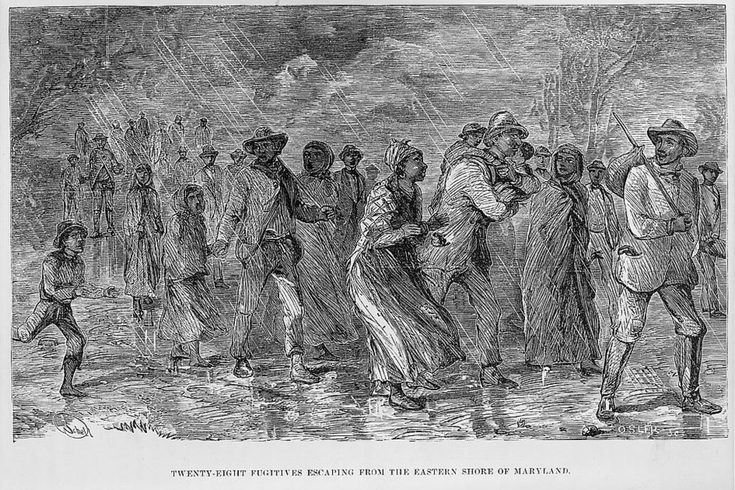 Provided Image/Library Of Congress Prints And Photographs Division
Some enslaved people who escaped to Philly came from the Eastern Shore of Maryland, researchers found. The image above is an illustration from William Still's 1872 book ‘The Underground Rail Road: A Record of Facts, Authentic Narratives, Letters' that shows 28 people escaping from Cambridge, Maryland.
By digitizing written records from a prominent Philadelphia abolitionist and employing modern mapping technology, a group of researchers at Temple University were able to trace the routes on parts of the Underground Railroad that were used by nearly 1,000 people to reach Philadelphia.
They found that enslaved people who escaped to the city from 1853 to 1861 most commonly came from areas in what is now Norfolk and Henrico County in Virginia; Dorchester and Baltimore counties in Maryland; and Sussex County in Delaware. The researchers hope this conclusion will create a more thorough understanding of how the network operated.
In a paper published in the International Journal of Humanities and Arts Computing, the research team led by geography professor Jeremy Mennis and African American studies professor Nilgun Anadolu-Okur referenced over 1,000 written accounts from the archives of William Still.
"These are incredibly compelling stories of escape from enslavement and freedom, giving us a personal view of ... where people escaping enslavement came from, how they traveled northward, and how physical, social and built environments either hindered or helped their journey to freedom," Mennis said.
Still, a Black abolitionist from Philadelphia, was commonly considered the "Father of the Underground Railroad." He spent years meticulously recording the stories of the escaped enslaved people he would assist and published them in 1871.
The analysis of Still's writings was then compiled into a yearly distribution of the origins and modes of travel of the people who were escaping slavery to Philadelphia. This data was then imported into a geographic information system.
"There are a lot of nuances involved because the location data are historical, so names of towns have changed over time, counties have split and there's a lot of variation in how names are spelled," Mennis said. "Once we got these locations mapped for different years, we ran basic summary statistics on the regions from where people escaped from, how they escaped, their age and so on."
Anadolu-Okur and Mennis found that within the timeframe studied, Norfolk and Henrico County yielded 122 and 61 escapes to Philadelphia, respectively. Dorchester County tallied 84, Baltimore 79 and Sussex County 48.
The presence of abolitionist Harriet Tubman, who helped dozens of people escape slavery through the Underground Railroad, was likely an important factor in where people were coming from. Tubman was known to be active along the Eastern Shore of Maryland, where she was born.
"The agency of specific people like (Tubman) in the case of Maryland and specific ship captains and railroad agents in Norfolk were responsible for the rapid rises in escapes," he said. "In both cases, these spikes in escapes were met by actions among enslavers who rallied political and legal efforts to stop further escapes. This seems to have quickly suppressed the rapid rise of escapes in both regions."
When compared to existing historical records about the region, the data gave more insight into escape patterns through regional "stations" of the Underground Railroad. For example, people coming from the southern Chesapeake Bay communities were more likely to travel by steamship or schooner to cross the Susquehanna River and traveled on foot as they got closer to Phoenixville. From there, associates with the network — referred to as "conductors" or "agents" — would direct escapees to Philadelphia.
The political landscapes of different regions along the Underground Railroad were also major contributors to how escapes were carried out and likely explained why the specifics associated with some regions of the route were more difficult to understand than others, Mennis said. For example, escapes seemed to peak between 1853 and 1857, but sharply declined afterward. This was likely due to the fallout of the Dred Scott v. Sandford case in 1857, when the Supreme Court ruled that African Americans — both enslaved and free — were not considered U.S. citizens.
"The (Underground Railroad) travel became very dangerous after that time due to increased presence of kidnappers along the routes, which promised income paid upon any escapee who was apprehended," Anadolu-Okur said. "Slave escapes did not stop around 1857. Rather, escaping became significantly more dangerous and the legacy destination for total safety shifted (from Philadelphia) strictly to Canada."
To explain the reasoning behind the travel patterns, the researchers had to work around certain unknowns related to Still's writings.
"I suspect Still kept some information intentionally hidden, in case his records were discovered," Mennis said. "He referred to many railroad conductors and agents through coded names, even though he knew many of them personally. ... Just keeping these records was incredibly dangerous to Still."
While the study's conclusions can be used to shed more light into the workings of the Underground Railroad, the researchers conceded that there are some elements of the network that may never be fully known. Variables such as the role of free Black people working in the shipping industries and the impact of the natural environment could also be evaluated in future research, they said.
In the meantime, Mennis has begun developing historical datasets of 19th century roads, towns and other features from historic maps to continue research in this field and published the geospatial dataset of escapee locations so that it can be easily accessed by other potential researchers.
"We don't know a lot about the specific paths many of those escaping took to get to Philadelphia from wherever they started," Mennis said. "I'd really like to map specific routes of individuals, but mostly the data just aren't there. … But, there's also the bigger question of just understanding the individual experiences of these people escaping slavery and how those larger, contextual, geographic forces impacted them."