




August 04, 2026
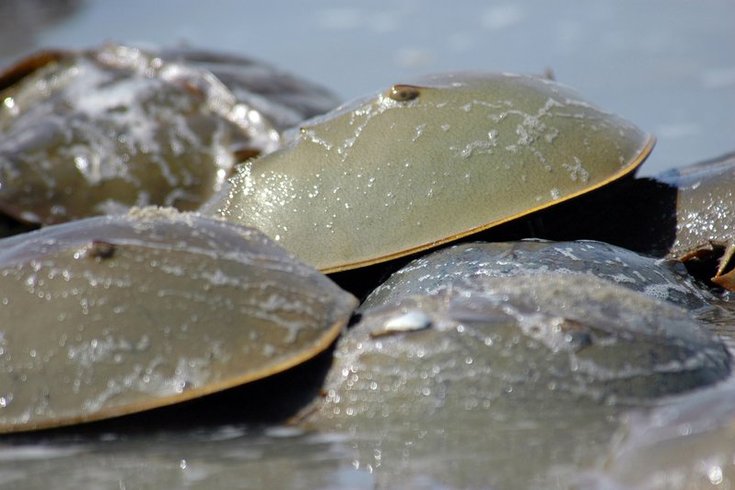 Gregory Breese/USFWS.
Horseshoe crabs have survived more than 400 million years, but some wildlife advocates and conservationists say they're being over-harvested for biomedical research and bait. A new petition claims New Jersey is not properly enforcing its moratorium on harvesting the species.
Wildlife advocates are taking aim at the New Jersey Department of Environmental Protection over a Cape May company's harvesting of horseshoe crab blood for biomedical research.
The nonprofit Center for Biological Diversity, joined by more than a dozen other organizations, claims NJDEP is not enforcing rules that were created to protect the species from harm and population loss during their collection. A petition alleges the state is allowing Cape May's Limuli Laboratories "to kill and injure horseshoe crabs in huge numbers," threatening a vital food source for migratory bird species that feed on their eggs.
"The Delaware Bay is like the stronghold of Atlantic horseshoe crabs, and it has seen a massive drop off of horseshoe crab numbers," said Danny Waltz, an attorney at the Center for Biological Diversity.
New Jersey passed a general moratorium on horseshoe crab harvesting in 2008, recognizing that migratory shorebirds like the red knot are impacted by depleted populations. Environmental advocates applauded the state's action at the time, believing New Jersey had stepped to the forefront of conservation, but some were unaware that a special permit still allows companies to harvest horseshoe crab blood for biomedical research only.
"New Jersey conservation organizations were shocked to learn that," Waltz said.
The earliest horseshoe crabs trace back more than 445 million years in the fossil record. All of the modern species of the arthropods have bright blue blood that gets its color from a copper pigment found in many non-vertebrates. Blood from horseshoe crabs contains a unique clotting feature that can be used to rapidly detect bacterial contaminants called endotoxins. For decades, biomedical researchers and pharmaceutical companies have used horseshoe crab blood to test the purity of intravenous drugs, vaccines and medical devices.
Groups like the Center for Biological Diversity and New Jersey Audubon argue the industry in the United States should move toward newer synthetic alternatives that are recognized by the U.S. Food and Drug Administration for meeting quality standards. Although independent scientific groups have approved and embraced the use of synthetic alternatives, the FDA has not formally updated guidance on them since 2012. The United States now lags behind Europe and parts of Asia that have encouraged the newer approach.
"The reason it hasn't been fully embraced is just bureaucratic inertia, more than anything else," Waltz said.
Some members of Congress have pushed the FDA to adopt policy change in recent years. U.S. Rep. Frank Pallone, whose New Jersey district covers parts of Middlesex and coastal Monmouth counties, joined conservationists last year in calling for new standards that would remove horseshoe crabs from the biomedical supply chain.
In New Jersey, the Center for Biological Diversity obtained NJDEP records to determine whether Limuli Laboratories is compliant with the rules of New Jersey's harvesting permit. The advocates estimate the company removes about 100,000 horseshoe crabs from New Jersey waters and beaches every year. They claim up to 30% of the creatures are killed in the process.
Limuli Laboratories and its founder, Benjie Swan, could not be reached for comment. The company's website is inactive and a voicemail box for its listed phone number does not take messages. Swan is a member of the Atlantic States Marine Fisheries Commission, which manages the conservation of fish and shellfish species for 15 coastal states. ASMFC estimates a lower death rate of about 15% of horseshoe crabs collected for blood drawing.
"(Benjie) actually was the original creator of the Delaware Bay Horseshoe Crab Spawning Survey back in the late '80s, early '90s," said Jordan Zimmerman, a Delaware state biologist who monitors neighboring horseshoe crab populations in the Delaware Bay.
Zimmerman said more recent population estimates for horseshoe crabs have been skewed by reporting disruptions during the COVID-19 pandemic, when fewer beaches were surveyed. He believes the available data has been misconstrued to present an especially dire outlook for the species. By Zimmerman's estimate, human exploitation of horseshoe crabs accounts for only about 1% of the population in the Delaware Bay, including both biomedical and bait harvests.
"There's over 60 million horseshoe crabs in the Delaware Bay," Zimmerman said. "... We're talking about an animal that survived — what, five mass extinctions? I have a feeling it's dealt with worse situations than what we're seeing right now."
The petition from the Center for Biological Diversity calls on NJDEP to investigate Limuli Laboratories and make a formal declaration on whether the company's practices have violated state law. The advocates allege Limuli Laboratories uses inhumane collection methods, including picking horseshoe crabs up by their tails, that can lead to injury or death.
NJDEP spokesperson Vincent Grassi declined to say whether the agency will open an investigation.
"Limuli Laboratories must apply annually to DEP’s Bureau of Marine Fisheries for a permit to collect horseshoe crabs for biomedical purposes," Grassi said. "Conditions of the permit include area restrictions, daily take limits, data collection, and mandatory reporting. These conditions are consistent with requirements established by the Atlantic States Marine Fisheries Commission Interstate Fishery Management Plan for Horseshoe Crabs."
ASMFC uses a 15% mortality estimate for horseshoe crabs that are collected for blood, which is about half the mortality rate cited by the Center for Biological Diversity. Limuli Laboratories is one of a handful of companies that collect horseshoe crabs to harvest blood in the United States, including Charles River Laboratories and Associates of Cape Cod in Massachusetts.
Zimmerman contends the benefits of harvesting horseshoe crab blood outweigh the risks.
"This is a health issue. It's quite simple," Zimmerman said. "If you're having an injection, or a vaccine, or a prosthetic, what would you rather have it tested with? Would you rather have it tested with something that that hasn't proven to be 100% reliable in certain cases, or would you go with the standard for the last 30 or 40 years?"
The Center for Biological Diversity has been fighting an uphill battle to have the federal government declare horseshoe crabs an endangered or threatened species. The nonprofit contends over-harvesting — especially for biomedical research — has led to population declines of up to 70% in the United States. The National Oceanic and Atmospheric Administration rejected the request to have the species federally listed two years ago, and the center filed a lawsuit in May claiming the denial is unlawful.
"They didn't pay attention to the Delaware Bay as a potential significant portion of the range, a place that could get special consideration," Waltz said.
Zimmerman believes many of the wildlife advocates have good intentions, but he said some of the activism misses a larger context and injects politics into management of the species. Delaware does not allow harvesting of horseshoe crabs for blood, but unlike in New Jersey, the males in Delaware waters are permitted to be captured for bait. Zimmerman doubts Delaware will allow blood harvesting. He said the bigger threat to the longevity of horseshoe crabs will be the effects of climate change on their habitats, which need more protection.
"We have a nation of peoples that want to question science, and that's unfortunate," Zimmerman said. "We have really good science in the management realm. We have a lot of confidence in what we believe to be the trajectory of the horseshoe crab population."
Waltz and other advocates contend New Jersey's permit exemption for blood harvesting is at odds with conservation efforts. Some rescue groups, like Return the Favor, patrol New Jersey's beaches to flip horseshoe crabs over when they become stranded after the tide washes them ashore. The organization's website says volunteers rescued nearly 141,000 horseshoe crabs last year.
"That image really sticks with me because it's very inconsistent with what's happening elsewhere," Waltz said. "On one beach you'll have all these horseshoe crab lovers coming out to flip over horseshoe crabs to make sure to save them from death. On the same beaches or right next door, you have Limuli Laboratories removing horseshoe crabs and taking them to some facility, stabbing them in the heart and draining their blood."