





August 26, 2026
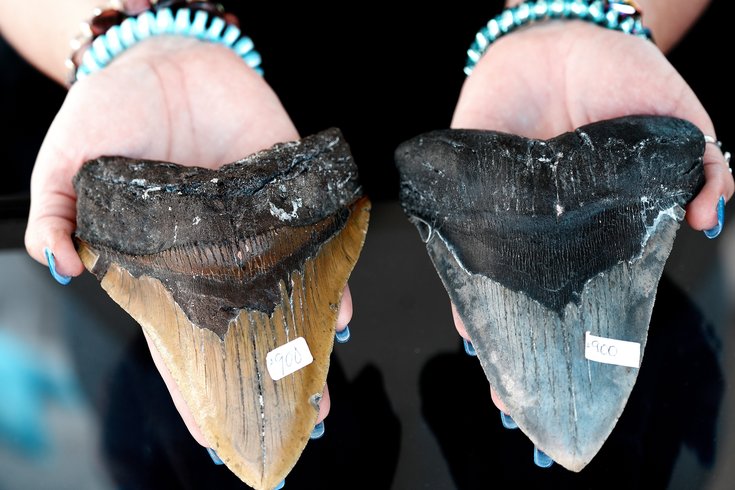 Thomas Bender/USA TODAY Network via Reuters Connect
A Pennsylvania family found a tooth from a megalodon, a prehistoric shark, in Sea Isle City this month, but how it got there remains a mystery. Above, megalodon teeth at the 2025 Sharks Tooth Festival in Florida.
While finding a megalodon tooth on a U.S. coastline isn't exceptionally rare, the prehistoric shark fossil that washed ashore in Sea Isle City is a "human mystery," according to Edelman Fossil Park and Museum Executive Director Ken Lacovara.
On Aug. 14, a family from Washington County, Pennsylvania, stumbled upon a massive shark tooth that was stuck in a rocky jetty, WGAL reported. Scientists at the Cape May Whale Watch & Research Center confirmed it was from a megalodon, a distant relative of the great white shark that roamed the seas millions of years ago during the Miocene era and could be up to 60 feet long.
Lacovara, a paleontologist, doesn't dispute the validity of the discovery, but he estimates that fossils of that age would be about 600 to 1,000 feet below the surface in South Jersey. From his perspective, there's no natural way the megalodon tooth could have gotten there, and it's more likely that it was brought to the jetty by a human and later found by the family. The time period is "not in contact with today's world" in Sea Isle, he said.
Fewer than five megalodon teeth have been found in the state and documented by the New Jersey State Museum, NJ.com reported. Melissa Laurino, the research director for the Cape May Whale Watch and Research Center, told the outlet that the center believes offshore dredging from a beach replenishment project might have brought the tooth to the shore, but Lacovara said the fossil would be too deep for excavation to unearth it.
"It's a real find, he found a piece of treasure on the beach, it's super cool," Lacovara said. "It's a megalodon tooth, but it's a mystery and it's a human mystery about how that fossil got there."
Megalodons lived approximately 23 million to 3.6 million years ago and could be found in waters all over the world. They were suspected to be about three times as long as a modern great white shark, although they're more closely related to a mako shark. Because of their massive size, their teeth are also extremely large, with some measuring over 7 inches long — more than double that of a great white.
Sharks can lose thousands of teeth throughout their lives, and megalodon remains can be found on coastlines where heavy erosion through the ages has exposed Miocene-era fossils. They're the state fossil of Georgia, and also turn up quite regularly near Calvert Cliffs in the Chesapeake Bay, where there are reportedly around 100 teeth found per year.
Because of the way the South Jersey coastline developed, though, beachgoers don't typically find anything that dates back further than 120,000 years.
And while there have been a few big storms this summer, Lacovara doubts that currents could have been strong enough to carry the tooth through the waters from a Miocene deposit to the Sea Isle shores.
"The storm waves here are generally not very competent, we would say, they're not moving big rocks around," Lacovara said. "So it's unlikely, and if it were happening with a shark tooth, you'd see other things other than the shark tooth — you'd see bigger rocks and such."