




August 20, 2026
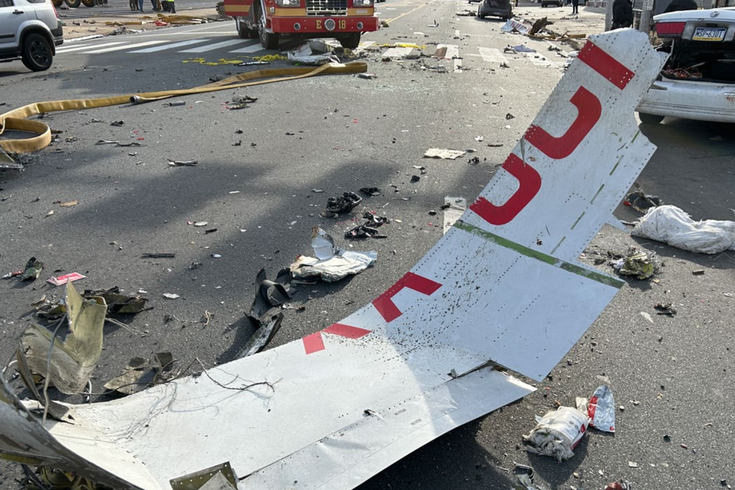 Provided Image/NTSB
New documents released by the National Transportation Safety Board shed light on the investigation into crash of a medical jet in Northeast Philadelphia on Jan. 31, 2025. Above, a portion of one of the LearJet 55's wings is shown amid the wreckage.
The National Transportation Safety Board released a trove of new documents Tuesday from its investigation of the medical jet crash in Northeast Philadelphia last year that killed all six people on board and two others on the ground.
NTSB investigators are still working to determine what caused the Learjet 55 to nosedive within a minute of taking off from Northeast Philadelphia Airport on Jan. 31, 2025. The twin-engine aircraft operated by Jet Rescue Air Ambulance accelerated to 275 mph during a rapid descent before crashing in the vicinity of the Roosevelt Mall along Cottman Avenue.
The four-person crew was transporting a mother and her 11-year-old daughter, a patient at Shriners Children's Hospital, home to Mexico. The plane took off on an overcast Friday evening.
The public docket released by the NTSB includes more than 1,500 pages of factual findings from the investigation, photos of the wreckage and new footage that shows the jet's sudden descent. Investigators have examined several factors that possibly contributed to the crash.
A flight instructor who had worked with the two Learjet pilots during training events described both men as "normal," "proficient" and "well prepared" when they had last attended a flight safety and simulation program in May 2024. Both men had thousands of hours of flying experience.
But NTSB investigators said the two pilots had been busy in the week leading up to the crash, flying multi-leg trips on each of the four days before Jan. 31, and might have been impacted by fatigue.
A review of human performance factors related to the crash discusses how "spatial disorientation" can affect pilots by distorting their sense of trajectory and position relative to the earth's surface. Pilots primarily rely on visual cues and flight instruments to avoid the effects of illusions while maneuvering aircraft.
"Pilots who are properly trained and current in instrument flying can normally use instrument information to overcome misleading sensations, however, even well-trained pilots experience sensory illusions from time to time," the report notes.
The flight instructor who worked with the pilots told NTSB investigators that the training event they attended in Arizona in 2024 did not teach or discuss spatial disorientation. Investigators believe it's possible fatigue and disorientation contributed to the jet's erratic movements around the time air traffic controllers lost communication with the pilots following takeoff. Even brief lapses in judgment can dramatically affect a flight's trajectory.
NTSB released files, new video of Medevac Lear Jet crash in NE Philly last Jan. 31, 2025. No final cause why this happened. Video of takeoff from west bound Grant Ave., then about a minute later, the crash. Huge debris field.https://t.co/k2em3IOtT7 #NTSB #Philadelphia https://t.co/sFTG9ARf8o pic.twitter.com/n6n0s5EYIP
— AC (@ACinPhilly) August 19, 2026
"Flight experiments show that varying amounts of time are required for spatial orientation to be regained after it has been lost," NTSB investigators said. "This can range from a few seconds in some situations, to tens of seconds or more in others. When there is a delay in regaining spatial orientation, a pilot may make inappropriate control inputs that place an airplane in an unrecoverable trajectory."
One flight instructor for the pilots' Learjet training noted that the pilot in command possessed "very good system knowledge," but that he had a "tendency to react before thinking through the problem" when encountering challenges. The instructor also noted the pilot tended to perform manual duties that would normally be done by the co-pilot while an aircraft is in autopilot, a habit that could interfere with concentration on flying.
The co-pilot was described as a "hard worker" with a "great attitude," but the flight instructor said he had an "evident" lack of recent experience flying a Learjet model similar to the one that crashed. Neither of the pilots had flown out of Northeast Philadelphia Airport prior to the night of the crash.
Even if the pilots attempted to correct course when the medical jet went off its trajectory, the failure to perceive small deviations "can cause a pilot to feel as if the airplane is straight and level when, in fact, its angle of bank is changing," NTSB investigators noted.
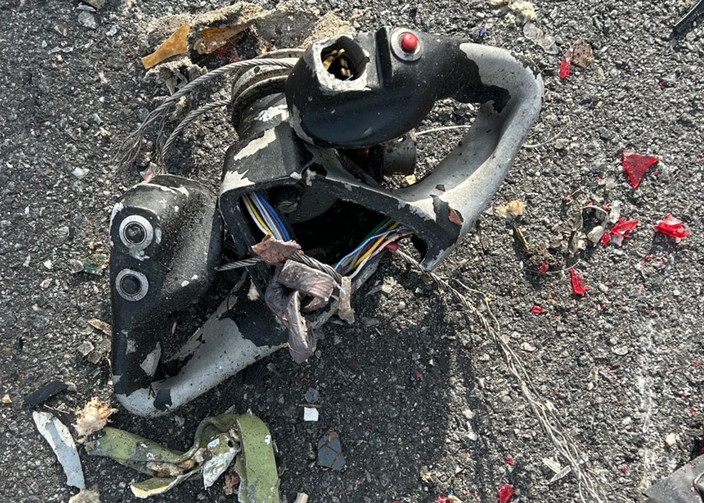
The co-pilot's control wheel from the Learjet was found amid the wreckage of the medical jet crash in Northeast Philadelphia on Jan. 31, 2025.
Jet Rescue Air Ambulance was established in 1994 as a medevac service with offices in Mexico and the United States. Its aircraft are registered in Mexico and the service operates on-demand flights with private customers. This means the Federal Aviation Administration's safety oversight is limited to ground operations.
NTSB investigators said four of Jet Air Rescue Ambulance's aircraft were permitted to fly in the United States with oversight from the FAA's field office in Dallas. The company had two crashes in Mexico in 2019 and 2023 and another off the coast of Fort Lauderdale, Florida in 2013, but the NTSB learned that an FAA inspector was unaware of these incidents and did not know whether the agency had conducted any inspections of Jet Rescue Air Ambulance's aircraft.
Transcripts of the NTSB's interviews with FAA inspectors show that ramp checks, the unannounced safety inspections conducted to ensure aircraft and pilots are up to standard, are more difficult to perform on unscheduled flights by international operators.
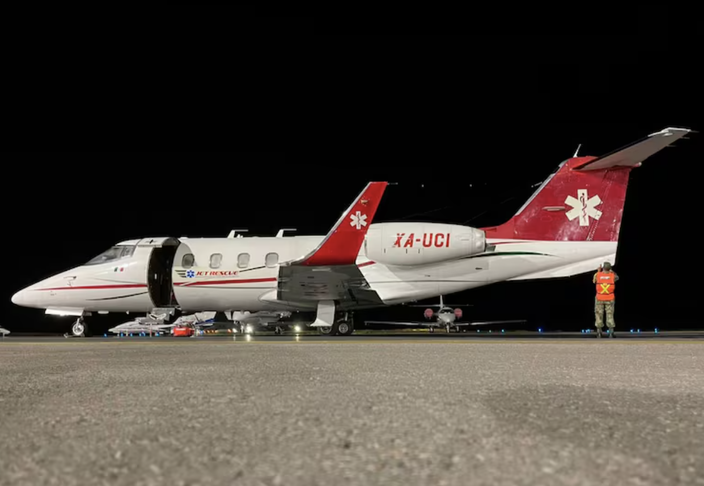
The Learjet 55 that crashed in Northeast Philadelphia was operated by Jet Rescue Air Ambulance, a Mexican company that provides medevac services worldwide.
When an aircraft flies between destinations far from the FAA office assigned to regulate it, a request can be made for another district office to complete a ramp check ensuring flight standards are met. But the Dallas inspector told NTSB investigators that he had never made such a request for surveillance and did not know whether doing so is periodically required.
The FAA has a Heightened Surveillance List for operators that have a history of crashes or other incidents, but Jet Rescue Air Ambulance was not on that list. The Dallas inspector said placement on the list is overseen by another entity within the FAA, and that individual field offices don't make the determinations that subject operators to more rigorous and frequent surveillance. The inspector said he had never dealt with an operator on the HSL and did not know exactly what responsibilities it would entail for his district.
"If I'd had one, I'd be deeper in the process," the inspector told NTSB.
NTSB investigators said the massive debris field of the crash covered 12 blocks. The most intensive wreckage was scattered within six blocks, and at least two dozen people were injured on the ground after impact. Much of what the agency recovered was severely damaged, making it difficult to assess conditions that might have caused equipment to fail or determine if the aircraft's settings played a role in the crash.
The cockpit voice recorder, recovered from a six-foot deep impact crater, was exposed to fuel, water and biohazards over a period of several days during the initial investigation at the scene.
Last year, the NTSB said the device contained no audio and appeared not to have been recording for several years. Since then, the agency has reconstructed the magnetic tape by splicing together segments to recover audio. Investigators found that the last recording came from a prior landing in Houston. It's not known why the cockpit voice recorder contains no audio. The Learjet 55, built in 1982, was not required to be equipped with a CVR.
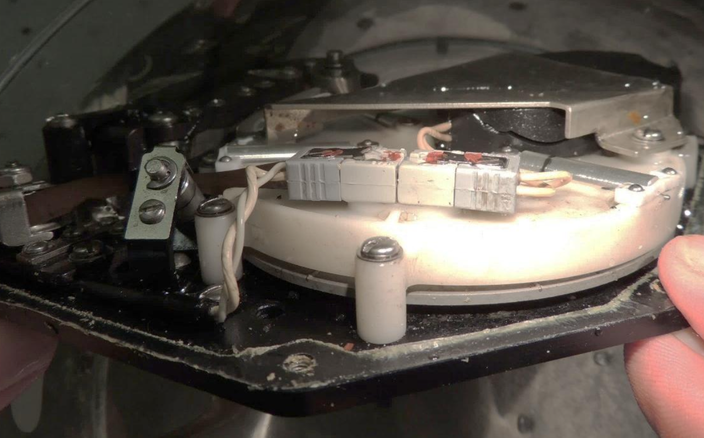
NTSB investigators recovered a recording from the Learjet 55's cockpit voice recorder by splicing together tape from the damaged device. There was no audio from the flight that left Northeast Philadelphia and crashed within a minute.
Among the other wreckage analyzed by the NTSB was the jet's pitch trim, a system that can be adjusted to take advantage of aerodynamic forces that affect the aircraft's angle and airspeed. This influences the amount of force a pilot needs to apply on the jet's controls. Investigators said they found pieces of the system indicating it had been set below a recommended angle, which would have required the pilot to exert more pressure to tilt the jet's nose up and down, but the NTSB said it's unknown whether this was a factor in the aircraft's loss of control.
Med Jets SA, the company that operates Jet Rescue Air Ambulance, has been hit with more than 100 lawsuits since the crash as federal claims seek pieces of the firm's $10 million insurance policy. Claims have been submitted by the families of victims, neighborhood residents and businesses impacted by the crash, insurers and the city of Philadelphia, which estimates the crash and its aftermath cost about $2.5 million.
The NTSB will produce a final report after its investigation is completed, a process that follows a six-month review before conclusions are made public.