



August 02, 2026
 Sammy Caiola/Chalkbeat
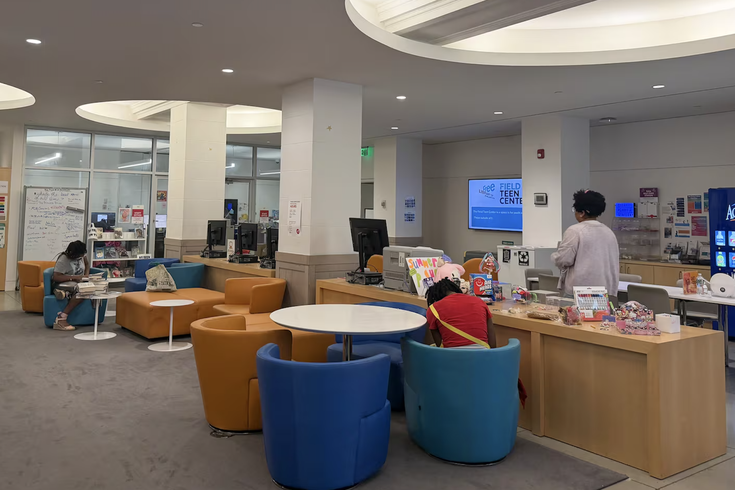
Philadelphia youth say third spaces such as the Field Teen Center at Parkway Central Library provide helpful places to go over the summer.
Earlier this year, 17-year-old Riyaz Brown-Cheeseboro walked into Center City’s Fashion District mall to do some afternoon shopping. She was by herself and minding her own business, she said, but mall security still escorted her out.
MORE: Public schools often lack sufficient support for students with concussions, report says
“They asked me for an ID, they walked me away, and I didn’t really know why.”
In 2023, following at least one instance of police responding to hundreds of teens at the mall, the Fashion District began requiring anyone under 18 be accompanied by an adult age 23 or older after 2 p.m. Minors who are working in the mall are exempt.
Teens feel excluded from other places, as well. They told Chalkbeat they’ve been asked to leave convenience stores, fast-food restaurants, university campuses and Center City parks.
"The attitude that's being shown to them is like 'you're not wanted in public spaces,'" said Kharma Hillian, 19.
That attitude may be heightened this summer due to a wave of teen takeovers, or pop-up events that spread on social media and involve large groups of young people. Law enforcement has responded to shootings and other crimes during these types of meetups in Chicago; Raleigh, North Carolina, and Newport Beach, California.
While teen takeovers do happen in Philadelphia, youth say it’s not fair to assume that any group of teens is going to cause trouble.
"I would say, like, 90% of the time, they're not up to bad stuff," said James Field, 16. "It's just people like to talk to each other and be social."
Field, Hillian, and other local students are producing a video segment for PSTV, the School District of Philadelphia’s television station, on the need for youth-centered third spaces. The term refers to places other than work or school where people can spend time. Many experts in adolescent behavior argue third spaces lower stress, improve confidence and increase academic motivation.
Hillian said if officials invested more in third spaces, they wouldn't have to worry about teen takeovers.
"If you give teens a proper sense of community and a proper place of belonging, then there will be no need for fighting, there will be no need for violence," she said.
Many of the city-sanctioned spaces for young people in Philly are in deep disrepair. The school district is closing 17 school buildings that it can't afford to fix or renovate. Meanwhile, some of the city's recreation centers are similarly dilapidated.
Hillian said this makes people her age feel like there's nowhere to go.
"Why invest hundreds and thousands of dollars into more police enforcement to make sure teens aren't in Center City, when all that money can be poured into redecorating existing recreational centers, and giving them art supplies and roofs and plumbing systems?” she asked.
The city's current budget allocates 10 times more to police than to the Parks & Recreation Department.
In 2017, the city invested more than $500 million to refurbish 72 recreation centers, parks and libraries in a massive undertaking known as the Rebuild project. Nearly a decade later, a little over half are complete, according to a 2026 progress report.
The city is responsible for maintaining public spaces where teens feel safe, including by offering more evening hours, said Inella Ray, an advocate at Children First PA.
She worries that without those spaces, Black youth will have encounters with police that could land them in the juvenile justice system. In June, she witnessed officers breaking up a crowd of boys who were sitting at a nearby table in Dilworth Park — a large, public plaza at the heart of the city that seems designed to draw young people with food stands, sprinklers, skating rinks and other activities.
"They were cracking jokes at each other, looking at girls, and all of a sudden these swarms of cops came and told them to disperse," Ray said. "This idea that the Philadelphia police are coming into contact with young people on the basis of existence, it's just a disaster."
Brown-Cheeseboro said it's OK for police to be on standby, but they should only intervene if something goes awry.
"We should be allowed to be in places, and once we overstay our welcome or are doing what's not allowed, we should be escorted out," Brown-Cheeseboro said. "That's how it should be. Instead of just immediately rejecting us."
Police provide necessary safeguards for large groups of young people, said 22nd District Capt. Brian Sprowal.
"I'm all for a meeting up, I'm all for kids being kids and doing what it is they like to do and engaging," he said. "However, sometimes history has shown us that without that supervision or without that guardianship, things happen."
The number of young people charged with crimes in Philadelphia dropped roughly 20% between 2024 and 2025, from 1,977 charges to 1,550, according to data provided to Chalkbeat Philadelphia by the District Attorney’s Office. The only category to see a slight uptick was robbery.
Jaylen Gordon, a rising high school senior who is not part of the video team, acknowledges that large groups of teens meeting up can be dangerous.
"With big parties and big linkups, it can lead to a shooting especially late at night," he said. "It can lead to a big fight when people meet up, knowing that somebody that they don't like could be there."
But he still doesn't get why he and his friends were dispersed while hanging out casually downtown this summer.
"Nothing was actually happening, and I was just really confused."
Cities experiencing teen takeovers have responded with a range of actions including curfews, social media monitoring, and ramped-up law enforcement. Detroit launched a late-night basketball program in a recreation center in an effort to curb unauthorized gatherings.
In Philly, city agencies do provide free programming for teens. The School District of Philadelphia offers a six-week summer camp at 30 schools and publishes a map of summer programs. The Parks and Recreation Department has a sortable directory of activities. The city also runs evening resource centers that are open from 7 p.m. to 2 a.m., and receive children who are brought in under the city’s youth curfew. Dozens of neighborhood nonprofits also create safe spaces.
This summer, the city’s Parks & Recreation Department has been holding sanctioned teen takeovers where young people can hang out, eat and dance. Their Summer Night Lights program with the police department has a similar goal.
Eric Westbrook, deputy director for community partnerships for the city’s Office of Public Safety, feels those initiatives have been helping young people stay safe.
"Let's look at our summertimes, when gun violence numbers tend to increase, and let's bring the resources to them," he said. "Our engagement doesn't have to be just strictly arrests. Our engagement should be connecting, making relationships."
But students say they want less structured spaces where they don't have to deal with many adults and can just relax.
Hillian's video team is highlighting the Field Teen Center at the Parkway Central Library, where the activities are informed by a Teen Advisory Board. They also point to the Ginger Arts Center in Callowhill, which has a karaoke machine and a ping-pong table, as an example of an ideal space.
The student project is part of WHYY’s Media Labs program and will be screened at WHYY on Aug. 5 from 4-7 p.m. alongside other participant work. Register for free here.
Sammy Caiola covers solutions to gun violence in and around Philadelphia schools. Have ideas for her? Get in touch at scaiola@chalkbeat.org. Chalkbeat is a nonprofit news site covering educational change in public schools.