




July 23, 2026
 David Sokol/USA Today via Reuters Connect
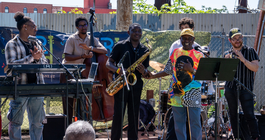
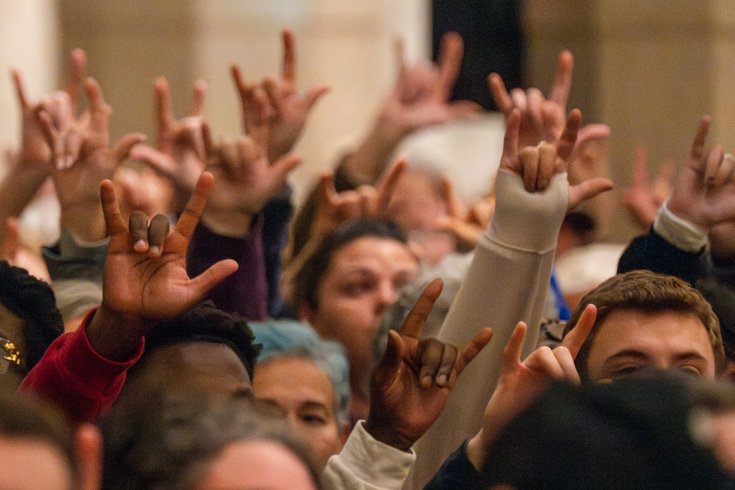
The Philadelphia deaf community has developed its own sign language 'accent,' and Penn researchers say they want to preserve the well-documented cultural phenomenon that is fading from popular use. Above, community members use ASL during a vigil in Maine in 2023.
How do you say the word "boss" in American Sign Language? In much of the country, signers will contract their fingers into a claw and tap their shoulder. But in Philadelphia, they might stroke a long invisible beard under their chin to say the same thing.
This difference is one example of the documented "Philly accent" in ASL. Just as city natives love to drop "jawn" or "crumb bum" in conversation, the local deaf community has developed numerous signs or ways of signing that are unique to the region. For the past 11 years, a trio of scholars has been trying to research and record this phenomenon before it disappears.
Jami Fisher is one of them. As a CODA — child of deaf adults — and born-and-bred Philadelphian, she's heard the accent her whole life. But increasingly, the University of Pennsylvania professor has also heard concerns from elders in the community that their special way of speaking is slipping away. Back in 2014, she started talking to her Penn colleague Meredith Tamminga about how to document this ASL accent. The pair reached out to Julie Hochgesang, a deaf professor of linguistics at Gallaudet University, to complete their research team.
"It's been a slow project," Hochgesang said via an interpreter. "But I think it's really good because there is a lot of data, there's a lot of process in this."
Together, the women launched the Philadelphia Signs Project. With the help of Fisher's father Randy and other interviewers, they've asked roughly 40 residents about how they sign "knife," "banana," "birthday" and other terms. Their research shows that some deaf Philadelphians don't just have their own terms, particularly for holidays and months, they position their hands differently on more common signs or take up more space while speaking.
"Many people in Philadelphia feel our signs are special, the way that we sign," Fisher, who frequently switches between signing and speaking, said via an interpreter. "Nobody else signs like us. That's how it feels. And we really want to focus on documenting that part because the community is proud of that."
As the trio has explained in academic papers, this accent was largely forged at the Pennsylvania School for the Deaf. Founded in 1820, it is the third-oldest deaf school in the country and was heavily influenced by the co-founder of the first — Laurent Clerc, the deaf Frenchman who formed the American School for the Deaf with Thomas Hopkins Gallaudet in 1817. Clerc served as a temporary headmaster at PSD, and researchers have observed traces of the Old French Sign Language he would've spoken in the Philly ASL accent.
For about a century, PSD was essentially the only option for deaf children in the region. It also, at least initially, encouraged teachers and students to communicate and learn through sign language. Oralist education, which employs speech and lip reading, was emphasized at the Archbishop Ryan Memorial Institute for the Deaf (in Logan Square) and Willis and Elizabeth Martin Orthopedic School (in Fairmount), which both opened in the 20th century. By that point, PSD also favored this approach.
Before the shift, however, pupils were fully immersed in sign language. PSD was a boarding school until the 1980s, when it moved from its longtime home in Mount Airy to its current location in Germantown.
"We used to have a deaf school where students would live, they'd eat, they'd sleep, they'd be socialized with deaf people, deaf children and deaf adults," Fisher said. "So they would be in the language and they'd be saying the language every day, all day. And they'd be able to pick that up."
The institute's embrace of oralism, which ended in the 1970s, disrupted that immersion, though children and even teachers continued to sign under threat of punishment. PSD's transition to a day school was perhaps more destructive. The Philly accent that Fisher, Tamminga and Hochgesang have observed is most prevalent in older adults who attended PSD before it ended its boarding program.
"Residential deaf schools are really good environments for language innovation and rapid change," Tamminga said. "You put a lot of children together learning and exploring their language, you're going to see things develop and change. ... So it's not that surprising that we would find differentiation in how ASL is associated with different deaf schools. And I think that's a really important structure and force in different regional varieties of ASL."
The tightly knit Philadelphia deaf community also helped incubate the accent. As the researchers noted in a 2018 paper, the vast majority of PSD alum came from the region and stayed there, not even leaving temporarily for college. The local deaf population "is known by insiders and outsiders to be highly insular and relatively unwelcoming of any outsiders, including Deaf outsiders," they wrote. Though it's easier to develop regional quirks in a small, close community, it also gives those dialects little room to spread.
A '70s law that required public schools to educate deaf children alongside their nondisabled peers as much as possible also restricted the flow. Enrollment at deaf schools shrank considerably in the following decades, including at PSD. The pre-K-12 school now has fewer than 150 students, according to 2023-2024 data. This federally encouraged assimilation is largely why, the researchers say, the accent is "fading." Children who still attend private deaf schools are usually just there for the day, then return to their families, who rarely share their disability. More than 90% of deaf babies are born to hearing parents.
Through their ongoing research — another paper is currently under peer review — Fisher, Tamminga and Hochgesang hope to preserve some semblance of this ASL accent, another proud Philly tradition.
"Without question, the urgency of immediate documentation could not be greater," the trio wrote.
Follow Kristin & PhillyVoice on Twitter: @kristin_hunt
| @thePhillyVoice
Like us on Facebook: PhillyVoice
Have a news tip? Let us know.