


September 28, 2026
 Provided Image/Philadelphia Phillies
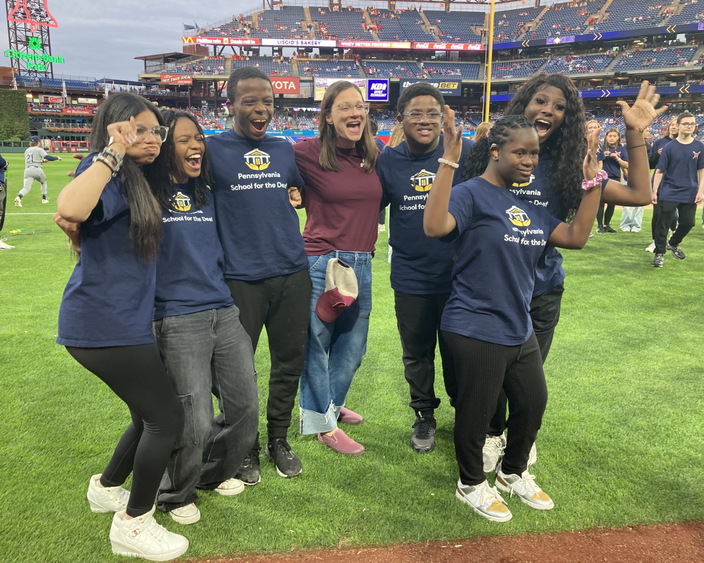
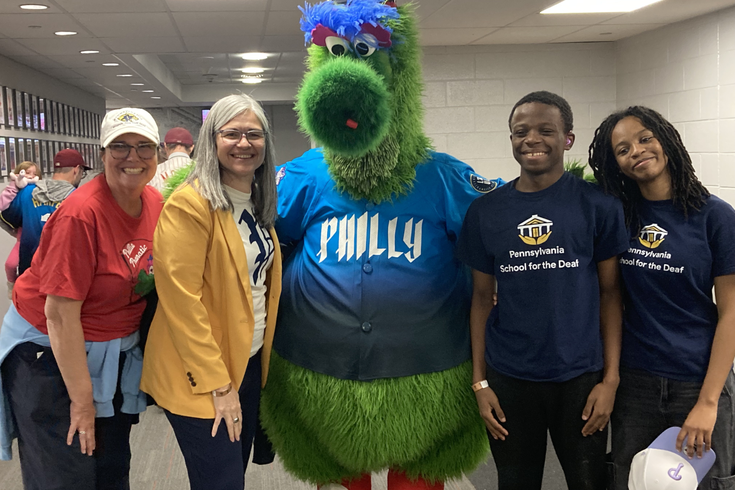
Students from the Pennsylvania School for the Deaf attended a Phillies game and performed the national anthem at Citizens Bank Park alongside a choir from Northern Burlington County Regional Middle School on Friday.
The Phillies' final homestand of the regular season appeared bleak until the bats came alive on Sunday and the team clinched a wild-card berth with their 7-3 win over the Tampa Bay Rays. The Phillies now head to Atlanta to start their postseason run against the division rival Braves on Tuesday.
To most fans, Friday night's 2-0 loss to the Rays probably looked a like a snoozer and a sign of impending collapse for the Phillies. But for a group of high school students at the Pennsylvania School for the Deaf, it was a chance to show the region their language and offer a window into a community that's often misunderstood.
That includes the way they experience a baseball game at the ballpark.
"Deaf people often feel like they are more attentive to the game — the details of the game, as opposed to hearing people," said Melissa Draganac-Hawk, who is deaf and serves as the head of school at PSD. "Hearing people depend on their hearing so much, and we are so attentive to the game of what's going on visually."
Whenever bedlam breaks out at Citizens Bank Park, deaf fans can feel the roar of the crowd rumbling through their chests. Instead of clapping, they use the American Sign Language equivalent called the deaf applause — a shimmering motion sometimes likened to "jazz hands."
A small group of PSD students took the field Friday night to perform the national anthem in ASL alongside a choir from Northern Burlington County Regional Middle School in New Jersey. About 100 PSD students, joined by teachers and family members, watched their peers from the stands as part of an event celebrating Deaf Awareness Month in September.
PSD was founded in Germantown in 1820 and is the third-oldest school for the deaf in the United States. It offers education and services to a spectrum of people who are deaf and hard of hearing from birth until they're 21. The school assists students' families and gives specialized training to prepare young people for the workforce. More than 40% of deaf adults in the U.S. are not employed, Draganac-Hawk said, but giving the public more exposure to the capabilities of deaf people helps break down barriers to opportunity.
"We want to get the word out," Draganac-Hawk said. "Deaf people can do anything they want. That's what our mission is. Don't be scared to meet a different person. Interact with them. Spend time with them. We really encourage that."
Ciarra Colefa, a senior at PSD, was among the students who performed the anthem Friday night. She said she's done so at a few sporting events over the years and each time is a chance for her to be an ambassador. She wants to see the public gain a greater sense of respect and recognition for the deaf community's vibrant culture and history, rather than viewing their sensory differences through the lens of sympathy.
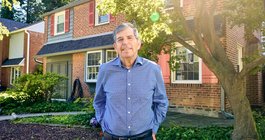
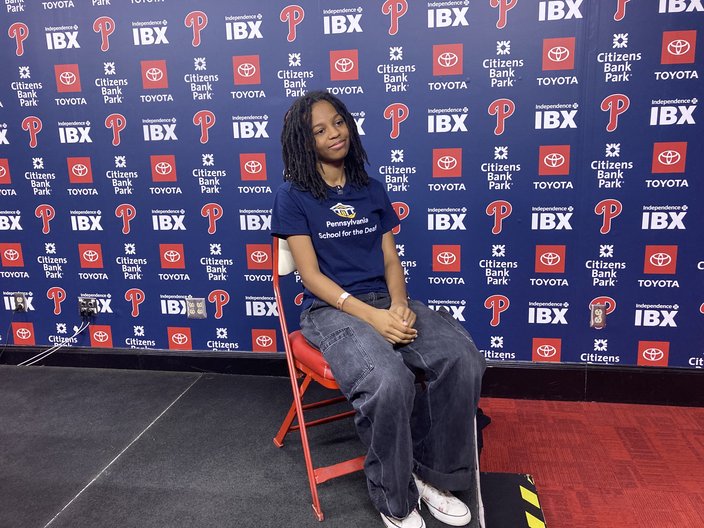
Ciarra Colefa, a 12th grade student at the Pennsylvania School for the Deaf, talked about the need for greater awareness of the deaf community and encouraged the public to learn American Sign Language.
"Deaf people are more than just broken," said Colefa, who's from Camden. "We have so much — so many leaders and people who really contribute to the world, and (people) have no idea. They're missing out on some amazing people, and they should really just go out there and talk to them. ... We have potential, and I would like them to see that."
In a bustling baseball stadium, coordinating an event with deaf students is no small task. It's not always immediately obvious that a person in a crowd is deaf, for one, and having interpreters around to communicate is essential to ensure things run smoothly. The PSD group practiced their routine in the tunnel a few times before heading out to the field with the choir from New Jersey.
"We started as two separate schools and two separate performing groups, and we ended as one really excited, cohesive performing ensemble," said Lauren Allen, the choir director for the Burlington County school. "... At the end of the day, music is an art form. It's an expression. It's a way that we express ourselves, and music is a language, just like ASL or any other language. To integrate that tonight was really special."
Students from the Pennsylvania School for the Deaf performed the national anthem at Citizens Bank Park alongside a choir from Northern Burlington County Regional Middle School on Friday.
6ABC community journalist Matteo Iadonisi, who was at the game to produce an upcoming segment about PSD's anthem performance, worked closely with an interpreter to film interviews with PSD students and staff.
Colefa, who cannot hear but is able to speak, pushed herself to use both her voice and ASL on camera. She knows reaching a large TV audience goes a long way toward overcoming stigma and misconceptions held by the general public. She encouraged people to spend time learning ASL, which is now the third-most commonly used language in the U.S. behind English and Spanish. It's deeply nuanced, often rich in detail and even includes localized gesturesthat can convey slang terms in a Philly "accent."
"Everybody can learn it," Colefa said. "I want you guys to learn it."
Levi Stokes, another PSD student from Chester, got his first chance to set foot on a baseball field Friday night.
"Man, I thought it was like no big deal, and then all of a sudden I got completely overwhelmed," Stokes said. "I thought I was going to mess up, but we did a great job."
Colefa said she's interested in studying law and psychology in the future. She's been inspired by the success stories of other deaf people, including actress Lauren Ridloff, who had a recurring role in "The Walking Dead" and has appeared in several Broadway productions.
"You'll notice that a lot of deaf people want to be actors because we are a very expressive community," Colefa said. "We like people watching our community."
At one point, the students got a chance to meet the Phillie Phanatic, whose own history is intertwined with the deaf community. Dave Raymond, the man who originally donned the costume, has credited his keen sense of non-verbal communication to being raised by a mother who lost her hearing when he was 3 years old.
Draganac-Hawk said the deaf community has come a long way over the past few decades, and a big reason for that is the presence of more interpreters. For the hearing community, there's an etiquette to working with an interpreter during a conversation with a deaf person. For example, it's polite to keep eye contact and speak directly with the conversation partner rather than the interpreter.
"They're not involved in the conversation at all," Draganac-Hawk said. "They're mediating the communication. They're facilitating that communication."
Draganac-Hawk thinks the Phillies and other pro sports teams could improve accessibility by making ASL part of the game-day experience.
"Our hope is that we show signing on the big screen in the future," she said.
Colefa believes greater awareness about the deaf community will help bridge gaps in understanding and encourage people to feel more comfortable building relationships.
"Don't be afraid to learn something," she said. "We're more than willing to help you guys. We're open and friendly."